Practical guide
Buying a Tea Gift Sampler: Information to Check Before Ordering
Choose the gift around the recipient’s format, preferences and brewing setup. Check distinct teas, quantities, the selected accessory option and each blend’s ingredients and precautions. Use the original checklist and printable tea cards to hand over usable instructions, with eight fictional examples for the decisions that commonly get confused.
Start with the recipient, then choose the box
A useful tea gift sampler combines teas the recipient wants with enough information and equipment to prepare them. Before comparing decorative tins or the largest variety count, find out their preferred format, ingredient requirements and brewing setup. A small set that fits those answers can be easier to use than a larger assortment containing several unresolved choices.
Ask about ordinary preferences without turning the gift into an interview about medical history. “Do you prefer plain tea or fruit and spice blends?” and “Would you rather use tea bags or loose leaves?” are often enough to begin. If the recipient gives you an ingredient exclusion or a firm caffeine requirement, treat it as a selection constraint rather than something to work around with a tasting suggestion.
| Topic | Question to ask | How to use the answer |
|---|---|---|
| Usual drink | Plain tea, scented tea, fruit or spice blends, or no established preference? | Use their stated preference; do not invent a favourite from their age or personality. |
| Format | Tea bags or sachets, loose leaves, or a format they specifically want to learn? | Match the gift to what they will actually prepare. |
| Available equipment | Mug, kettle, infuser, teapot, temperature control or another stated setup? | List the missing item before choosing a tea-only option. |
| Caffeine requirement | Is there a requirement for every selection, or simply a preference? | Obtain information for each blend; leave unknowns visible. |
| Ingredient exclusions | Which ingredients or precautions does the recipient need you to respect? | Check complete per-tea ingredient information and current precaution wording. |
| Use and gift size | Everyday familiar cups, a few new styles, or a broader discovery box? | Distinguish variety count from quantity and repeat portions. |
If the gift is a surprise, use preferences you actually know and mark the rest as unknown. “They drink tea at work” does not establish access to an infuser, and “they like flowers” does not establish a preference for floral tea. When a required fact is missing, ask a discreet, general question or choose a gift arrangement that lets the recipient select the contents.
Set a total budget covering the tea, any genuinely needed accessory and delivery. Check the current seller’s terms for the destination and occasion. There is no universal delivery interval or return rule for tea gifts.
Separate variety count, quantity and the selected option
Read a sampler listing as a contents list, not just a large number on a gift-box image. Keep the number of portions, number of distinct teas and quantity of each tea in separate fields. For loose-leaf samples, grams or another declared net quantity describe what is supplied; a cup estimate also requires a preparation amount and serving volume.
| Listing field | Check | What not to infer |
|---|---|---|
| Pieces / sachets | How many individual portions or packets are supplied? | A packet count is not automatically a count of different teas. |
| Distinct selections | Which named teas are included, and which repeat? | A repeat can provide another cup of a favourite; it does not add a new variety. |
| Loose-leaf quantities | What is the net amount of each tea, and are quantities equal? | A list of 12 teas does not establish equal weights or 12 cups. |
| Exact option | Does the selected option include a mug or brewing vessel? | A photo showing an accessory does not prove it is in the tea-only option. |
| Substitutions | Can contents change, and how will changed information be supplied? | An older contents image may not describe the assortment delivered. |
Two real product pages illustrate the difference. When checked on 2026-10-31, Rishi’s Sachet Collection Sampler described a 24-piece collection of 19 teas. Its expanded contents panel marked five selections with “2x”: Earl Grey, Lavender Mint, Matcha Super Green, Tangerine Hibiscus and Turmeric Ginger. Nineteen distinct selections plus those five additional portions account for 24 pieces. Calling this “24 different teas” would change the seller’s actual description.
The same page offered “Sachets & Mug” and “Sachets Only.” The Premium Loose Leaf Tea Sampler offered “Tea & Simple Brew” and “Tea Only,” and listed 12 teas. These are examples of information to verify, not a recommendation or a comparison based on drinking the products. Contents, options and availability can change; check the current selected option before ordering.
Decide whether repeat portions suit the gift. They can be useful when the recipient wants familiar cups, while a discovery gift may prioritise more distinct selections. Neither arrangement is inherently better. Compare what the recipient can use, and avoid calculating “cost per tea” using packet count for one box and variety count for another.
A tea-name list is not a complete ingredient list
A heading called “Ingredients” can still contain only the names of the teas in an assortment. On the two Rishi sampler pages above, the expanded panel lists selections such as Chamomile Medley or Masala Chai. Those selection names alone do not enumerate every component in each blend. Obtain the current ingredient information for the individual teas when it matters to the recipient.
Keep flavour descriptions separate from ingredient evidence. “Nutty,” “malty,” “floral” or “fruity” can describe a seller’s expected flavour; they do not by themselves identify an added nut, malt, flower or fruit ingredient. Conversely, a blend name that sounds simple does not prove that it contains only tea leaves. Use the actual ingredient declaration and any accompanying precautions.
There is a concrete reason to look beyond the box title. The Premium Loose Leaf Tea Sampler page, when checked on 2026-10-31, displayed this precaution in its expanded panel:
“Hibiscus flowers may be intercropped in fields that also grow peanuts. May contain peanut or peanut shell fragments. Caution for individuals with severe peanut allergies.”
This is the seller’s wording for that product page, not a finding from our own testing. Do not remove the warning when making a gift card, reinterpret it as permission for a small taste, or apply it to every tea from the brand. If the recipient has a relevant exclusion, resolve the exact product question before selecting it; choose another suitable arrangement if it remains unresolved.
Caffeine information also belongs to each selection. A mixed box containing botanical blends and tea leaves does not become entirely caffeine-free because one related product is described that way. Ask for per-tea information when every item must meet a requirement. Do not infer a precise amount from the colour of the tea, its taste or the word “relaxing.” This guide does not assess an individual’s medical requirements.
Make sure the recipient can prepare the actual selections
Start from the equipment the recipient has, then read each tea’s instructions. Sachets may fit someone who wants a straightforward mug routine. Loose leaves require a way to separate leaves from the prepared drink unless the particular method says otherwise. A brewing accessory is useful when it solves a known gap; it adds little when the recipient already has a suitable vessel and prefers a tea-only gift.
| Field | What to copy | Common mismatch |
|---|---|---|
| Amount of tea | Copy the product’s amount and unit for the stated method. | Do not convert a teaspoon to grams without measuring or a product-specific equivalence. |
| Water amount | Record the stated water volume and the vessel it refers to. | A large mug and a small tasting vessel do not imply the same dose. |
| Water temperature | Keep the temperature, unit and source together. | Do not silently give every selection one universal temperature. |
| Steep time | Copy the initial time for that tea and method. | A repeated-infusion sequence needs its own directions if supplied. |
| Finishing the brew | Say whether to remove the sachet, strain leaves or decant the liquor. | The recipient needs to know how to stop the stated steep. |
| Equipment and extras | List any infuser, whisk, filter or other item the instructions require. | Do not assume all products with “matcha” in the name use the same preparation method. |
The Tea and Herbal Association of Canada’s brewing overview identifies water temperature, tea amount and steeping time as factors affecting the cup, and describes straining the infusion or removing tea bags after steeping. Use that as a checklist of variables. For a mixed gift box, keep the current instructions for each product rather than replacing them with one category chart.
If a seller’s instructions omit the water amount, ask for it. “Steep for three minutes” does not tell the recipient whether the amount supplied is intended for a small cup or a large pot. If instructions disagree between the package and an older product image, preserve the discrepancy and seek the current directions instead of averaging the numbers.
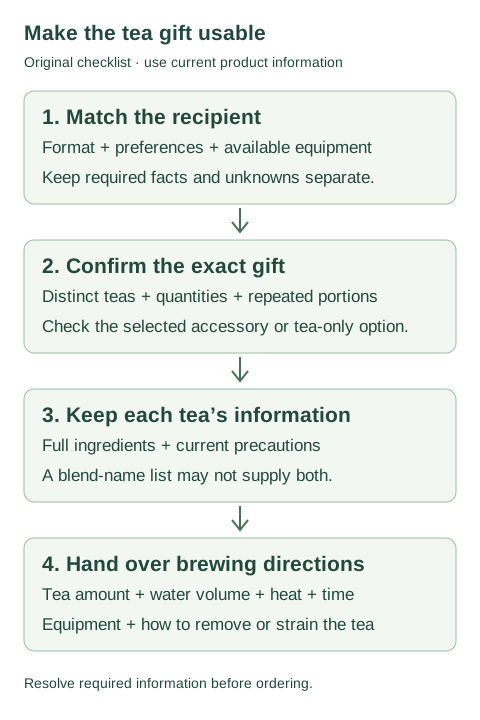
Include a short card that makes the gift usable
Make one box-level note and one small record for each selection. The box note names the exact assortment and option, identifies what equipment is included and points to the current instructions. Each tea record carries its full name, amount supplied, ingredient-information source, relevant precautions and brewing directions. Keep original packaging with the teas; the card helps locate information rather than replacing the label.
Use plain language. “Remove the sachet after the stated time” is more useful to a new tea drinker than a paragraph about the romance of the tea’s origin. Leave a field marked “not supplied—ask seller” when information is missing. A blank masquerading as a checked fact can be more confusing than an explicit question.
Download the recipient brief, three tea cards and seller-question template. The plain-text sheet can be filled out or printed. Duplicate the tea-card section for the number of selections actually supplied; the three blank cards are a starting layout, not a claim that every sampler has three teas.
Fictional handoff example: Alex prefers sachets, uses a mug at work and wants a few familiar teas plus two new styles. The gift note says “sachets-only option; no mug included,” because Alex already has one. A tea card records the exact sachet name and packet count. Its ingredient and brewing fields are copied from that product’s current label, with a source and date; they are not filled from a different tea in the assortment. Any required caffeine information still missing is a reason to finish the selection check before buying.
After opening, the recipient can choose a familiar tea first and follow its directions. If they want to experiment later, the tea brewing log provides a separate way to record adjustments. They do not need to run a formal tasting exercise to enjoy a gift.
Ask questions the seller can answer about the exact gift
A useful question identifies the product and selected option, then asks for a missing fact. “Is this a good tea gift?” invites a broad sales answer. “Does the sachets-only option contain a mug?” or “Where are the per-blend ingredients?” gives the seller something concrete to confirm.
The following is a template to adapt, not a message sent on your behalf. Include only the ordinary product requirements needed to answer your question. You do not need to send the recipient’s private health history to ask where current ingredient information is published.
- Exact contents: For this selected option, can you confirm each tea name, number of packets or net quantity, and any planned substitutions?
- Ingredients: Where can I find the current full ingredient declaration and precautions for every selection in this assortment?
- Caffeine requirement: Which selections have the caffeine information needed for the recipient’s stated requirement? Please identify any item for which it is not available.
- Instructions: Can you provide the tea amount, water volume, temperature, steep time and required equipment for each selection?
- Included accessories: Does this exact option include the pictured mug or brewing vessel? Which additional items are needed to follow the instructions?
- Delivery and problems: For this destination and occasion, what are the dispatch and delivery estimates, substitution policy, and process for a missing, damaged or unsuitable item?
Save the answer with the exact product name, option and date. If a requirement remains unanswered, keep it as unresolved rather than turning a reassuring phrase such as “natural ingredients” or “something for everyone” into evidence. A seller’s flavour description can help choose a style, but it does not settle missing ingredient or quantity information.
Eight fictional gift decisions to check your brief
These original situations test information reading. They are not product tests, medical advice or reports from recipients. Open each answer to see the specific fact that decides the next step.
Case 1
A box says “24 pieces” and lists 19 named teas, including five marked “2x.” Does it offer 24 different teas?
Show answer and explanation for case 1
No. It offers 19 distinct selections and 24 pieces.
The repeated portions increase the quantity without creating new varieties. Record both numbers when comparing boxes.
Case 2
The main photo shows a mug, but the option you selected says “Sachets Only.” What should the gift card say?
Show answer and explanation for case 2
Record the selected option and confirm whether any mug is included; do not infer inclusion from the photo.
The same product listing can offer accessory and tea-only options. The gift needs the contents of the option actually ordered.
Case 3
A recipient wants every selection to meet a caffeine-free requirement. A related-product card calls one botanical blend caffeine-free. Is the mixed sampler established as suitable?
Show answer and explanation for case 3
No. Obtain information for every selection in the actual sampler.
A claim attached to one related product does not describe all the contents of a different assortment.
Case 4
An “Ingredients” panel lists 12 tea blend names but no full per-blend declarations. Have you finished the ingredient check?
Show answer and explanation for case 4
No. Locate the current ingredient information and precautions for each blend.
A contents list tells you which selections are present. It may not tell you every ingredient within those selections.
Case 5
A current product page carries a precaution relevant to an ingredient the recipient must exclude. Can you remove it from the card because the box is a small gift?
Show answer and explanation for case 5
No. Keep the exact precaution and resolve the product choice before purchasing.
Gift size does not change the warning or establish personal suitability. A tasting experiment is not the missing ingredient check.
Case 6
A loose-leaf sampler lists 12 teas but no per-tea weights in the text you have. Can you promise 12 equal-sized servings?
Show answer and explanation for case 6
No. Ask for the amount supplied for each tea and its preparation directions.
Variety count does not establish equal weights, serving volume or the number of cups.
Case 7
The recipient owns only a mug. You choose loose leaves whose instructions require straining. What is the missing step?
Show answer and explanation for case 7
Confirm a suitable way to separate the leaves, include the needed accessory if appropriate, or choose a format that fits the mug routine.
Choosing an attractive tea does not provide the equipment needed to follow its preparation method.
Case 8
An older saved image and the current selected option list different teas. Which contents go on the card?
Show answer and explanation for case 8
Resolve the current contents and any substitution before filling the final card.
Keep the source and date attached to the exact gift. Do not combine two versions into an assortment neither source actually describes.
Finish the check before ordering, then check the handoff
Before paying, compare the recipient brief with the actual selection: format fits their setup; required ingredient and caffeine information is available; quantities and repeat selections are understood; the chosen option includes the equipment you intend to give. Read the current destination-specific delivery and problem-resolution terms. For a deadline, distinguish a dispatch estimate from an arrival estimate.
If the gift ships directly, confirm that useful instructions will travel with it. A product link in your browser is not automatically something the recipient receives. Include the card through an available gift-note option or pass it to them separately, keeping any original labels and precautions intact. Check whether prices appear in the paperwork if that matters to the occasion.
When the box arrives, compare the supplied contents with the confirmed list. For a substitution, update the tea card from the replacement’s actual information. If packaging or instructions are missing, ask the seller about the exact item before treating another selection’s label as a substitute. Follow the current storage directions supplied with the tea.
The gift is ready when the recipient can identify a tea, find its ingredients and precautions, and prepare it with the equipment available. Broad assortment size and premium language do not perform those jobs. For choosing samples for your own comparisons rather than a gift, continue with how to buy tea samples; for label and freshness questions, return to the tea buying guide.
Sources and further reading
- Rishi Tea: Premium Loose Leaf Tea Sampler — Current Product Example12 listed selections, Tea & Simple Brew / Tea Only options, blend-name contents panel and its exact hibiscus/peanut precaution. No first-hand tasting or recommendation inferred.
- Rishi Tea: Sachet Collection Sampler — Current Product Example24 pieces versus 19 distinct selections, five explicitly repeated selections, Sachets & Mug / Sachets Only options and the contents-list limitation.
- Tea and Herbal Association of Canada: How to BrewTemperature, amount, time and separation after steeping as information fields. Its category chart is not used as a universal recipe for every item in a gift.
Read the full US package before choosing a blend
Use the US ingredient and allergen label checklist for each exact packaged selection. Keep flavor descriptions separate from ingredient declarations and unresolved precautions.