Practical guide
Yellow Tea vs Green Tea: Processing, Labels and Flavor Descriptions
Chinese yellow tea includes menhuang, a warm, moist yellowing stage, in a process that shares important early steps with green tea. That processing information is a stronger category clue than a yellow-looking infusion or a promise of mellow flavor. Use the diagram below to understand the distinction, then check what a seller actually says about the particular tea.
The useful difference is processing
Green tea and Chinese yellow tea are not distinguished simply by the color you see in a cup. Both are made from tea leaves, and the processing routes share early preparation and heat-treatment steps. Yellow tea adds a yellowing stage, commonly called menhuang or 闷黄. The stage is carried out with warm, moist leaves and helps develop the finished tea's character.
The comparison here concerns yellow tea as a Chinese processing category, sometimes called huangcha. A product described as “yellow” because of its cultivar, pale leaves, packaging color or infusion needs more information before you can place it in that category. A name can carry several kinds of information at once.
Ask a process question first: does this tea have the yellowing stage associated with yellow-tea manufacture? Then ask about its origin, harvest, cultivar and preparation. Those details help identify what is being sold, but an origin or a leaf color alone cannot substitute for an explanation of processing.
This distinction also keeps expectations realistic. A processing category describes how a tea is made. It is not a guarantee that every batch will have an identical aroma, taste, caffeine concentration or quality.
Follow the shared steps and the yellowing branch
Download the original processing comparison as SVG
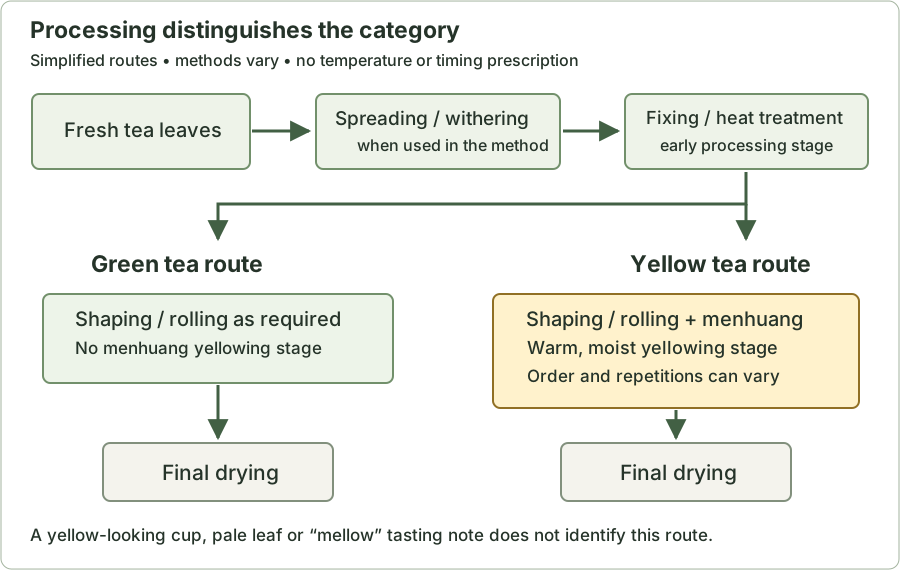
Shared early work: fresh leaves are prepared, with spreading or withering used according to the method, and undergo fixing, an early heat treatment. “Fixing” in a processing description does not mean repairing a defective tea. It names a production step.
The green route: shaping or rolling and drying produce the finished green tea without the menhuang stage that distinguishes the yellow route in this comparison. The drawing is deliberately broad; it does not imply that every green tea is rolled into the same shape.
The yellow route: shaping or rolling is combined with a warm, moist yellowing stage before the final dried tea is completed. The order can vary. A seller's description of a yellowing step before rolling is therefore not automatically inconsistent with one that places it after rolling.
The diagram explains a category, not a home-processing recipe. It gives no universal temperature, humidity or holding time because actual methods differ. Trying to reproduce a laboratory treatment from a chart is a different task from choosing a finished tea.
What a same-material comparison can show
A 2024 study in Food Chemistry: X compared green- and yellow-tea processing using the same fresh material: Yinghong No. 9 leaves with one bud and two leaves. The researchers sampled material through processing and analyzed non-volatile compounds, alongside sensory assessments. Using shared starting material helped them investigate what processing contributed to the difference.
In that study, the yellow-tea treatment included sampling at several yellowing durations. The finished yellow tea assessed after 48 hours of yellowing was described as sweet and mellow, while the green tea was described as bitter, astringent and sweet. Those are reported findings for the study's material and treatments. They are not our own tasting notes and do not establish that all yellow tea is sweeter than all green tea.
The distinction between bitterness and astringency is useful when reading those descriptions: the paper treats them as separate sensory attributes. A seller who uses “smooth” or “mellow” may be describing an overall impression rather than providing a measured comparison of those attributes.
The same study reported an orange liquor for its green-tea sample and a bright yellow liquor for its yellow-tea sample. That specific result is another reason to avoid a simple rule that a green tea must always make a visibly green cup. It does not mean every green tea brews orange.
The strongest takeaway is the role of processing, not a universal flavor ranking. The study gives evidence about a particular comparison under specified conditions. Your purchased tea may differ in raw material, production method, storage and brewing.
Why a single yellowing time is not a definition
A second 2024 study, published in Foods, investigated volatile compounds during yellowing under different temperature and humidity conditions. It used Longjing 43 material and sampled the treatments over time. Different conditions produced differences in the measured volatile profiles.
That is useful evidence that “has a yellowing stage” does not tell you every detail of the finished product. Duration, environment and starting material matter. It also explains why a seller's brief category description should not be stretched into an exact aroma prediction.
Neither study supplies a universal number of hours that every authentic yellow tea must undergo. A processing description can be informative without listing a factory's complete recipe. Look for a coherent account of what was done, and ask a focused question when the name and process description do not fit together.
Changes in measured compounds are not, by themselves, evidence that one tea delivers superior health outcomes for a drinker. These are processing and chemical studies. This comparison does not use them to recommend yellow tea as a treatment, a detox drink or a caffeine-free alternative.
Read label words according to the evidence they provide
| Wording you might see | What it tells you | What remains to check |
|---|---|---|
| “Chinese yellow tea; warm, moist yellowing after fixing” | A relevant category claim and processing explanation. | Which exact product, producer and batch the explanation describes. |
| “Golden-yellow infusion” | A description of expected appearance. | Whether the tea underwent menhuang; color alone is insufficient. |
| “Mellow and sweet” | A tasting description or expectation. | Who described it, under what brewing conditions, and how it was processed. |
| A cultivar or regional name | Information about plant material or origin. | The finished tea's production category and method. |
| “Rare,” “premium” or a high price | A marketing or pricing claim. | Product identity, processing information and the basis of any quality claim. |
No single row authenticates a purchase. A processing explanation is relevant evidence, but you still need to match it to the item being sold. A generic educational paragraph copied onto every listing is less informative than a description that identifies the product and its actual production method.
If a listing mentions added flavorings or a blend, read that information separately. An added aroma does not establish that the base tea was made by the yellow-tea process. Keep the ingredient question and the production-category question distinct.
Four focused questions for an unclear listing
You do not need to ask for confidential production settings to clarify a category. These questions seek information that would help an ordinary buyer understand the description:
- Is this Chinese yellow tea as a processing category? If “yellow” refers to a cultivar, leaf appearance or blend name, ask the seller to say so.
- Does this exact tea undergo menhuang? Ask for a brief description of the yellowing stage and where it fits relative to fixing and shaping or rolling.
- Which tea does that explanation describe? Match the producer, variety, origin and harvest or batch details that the seller actually provides.
- Whose flavor description is this? Ask whether it is a producer's note, the seller's assessment or a broad category expectation, and whether brewing guidance accompanies it.
A useful answer might identify the production category and explain that warm, moist yellowing follows an early heat-treatment step. An answer that only repeats “the cup is yellow” has not answered the processing question.
These are suggested questions, not inquiries already sent to a producer. No manufacturer reply, certification or product authentication is implied. If the listing remains unclear, you can record the category as unconfirmed or choose a tea with a clearer description.
Four cases: separate a clue from a conclusion
These original, simplified cases practice reading a description. They do not describe tested products.
Case 1
A seller calls a tea green tea and says it makes a golden-yellow cup. No yellowing stage is mentioned. Does the cup color establish that it is Chinese yellow tea?
Show answer and explanation for case 1
No. The appearance does not establish the processing category.
Ask about the actual manufacturing method if you need to clarify it. A yellow-looking infusion is compatible with a color description; it is not independent evidence of menhuang.
Case 2
A listing identifies Chinese yellow tea and describes fixing, warm moist yellowing, rolling and drying. Another description places yellowing after rolling. Must one be wrong solely because the order differs?
Show answer and explanation for case 2
No. The order of yellowing and rolling can vary.
The comparative study explicitly describes yellowing before or after rolling. Check the exact tea and its stated method rather than turning one simplified sequence into a universal rule.
Case 3
You read that a studied yellow tea was sweet and mellow after 48 hours of yellowing. Can you promise that a different purchased yellow tea will be sweeter than any green tea?
Show answer and explanation for case 3
No. The finding belongs to the studied samples and conditions.
Raw material, processing and brewing differ. Attribute a reported study result to that study, and keep your own future tasting observations separate.
Case 4
A product is expensive and says “rare yellow-leaf cultivar,” but gives no production category. Is its price or cultivar description enough to classify it as menhuang-processed yellow tea?
Show answer and explanation for case 4
No. Those details do not answer the processing question.
Ask whether “yellow” refers to the plant material or to Chinese yellow-tea manufacture. The relevant evidence is an explanation of the actual processing route for that product.
Keep category, flavor and preference as separate conclusions
When you compare finished teas, you can reach three different conclusions. Category: the product information describes a yellowing stage. Observation: your particular brewed cup has a flavor or appearance you can describe. Preference: you enjoy that cup more or less than another one. A preference does not prove the category, and the category does not decide your preference.
If the task is choosing what to buy, prioritize a clearly identified product, useful processing information and a suitable amount to try. A small sample can help you explore preference without treating a category-wide flavor promise as a certainty. For brewing, start with guidance for the exact tea and adjust carefully; this processing diagram does not provide a universal yellow-tea temperature or dose.
A defensible comparison might read: “Both are tea-leaf products; this yellow tea's description includes menhuang. The seller describes it as mellow, but I have not tasted this batch.” That sentence gives the reader useful information while preserving what remains unknown.
Sources and further reading
- Sun and colleagues (2024), Food Chemistry: X: Study on flavor quality formation in green and yellow tea processingShared-material processing comparison, variable position of yellowing, and sensory results limited to the specific studied samples and treatments.
- Wang and colleagues (2024), Foods: The Effect of Temperature and Humidity on Yellow Tea Volatile Compounds during Yellowing ProcessA specific experiment showing that yellowing conditions affect measured volatile profiles; not a universal recipe, quality ranking or health-outcome study.