Practical guide
Cold Brew Tea Bottle Filters: Leaf Placement and Coffee Compatibility
Hario’s tea and coffee cold-brew filters are not described as the same mesh: its FAQ says tea filters are coarser, so coffee grounds can pass through. Its Filter-in Bottle strains at the spout, while HCC holds leaves in a removable basket. Choose the intended product and a real leaf-separation step; do not infer universal interchangeable parts.
On this page
Find where the leaves sit
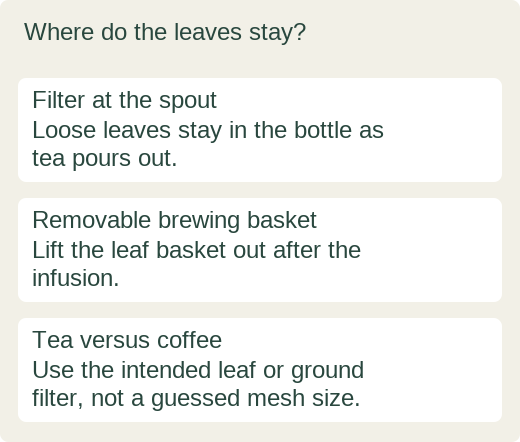
Two containers may both have a “tea filter” while placing the leaves differently. Hario’s Filter-in Bottle fixes the filter at the spout so tea can pour through it. Its HCC MIZUDASHI pot instead places leaves inside a brewing basket and says that basket can be removed after the infusion. Identify that arrangement before choosing how you will end contact or clean the container.
On a phone, scroll within the table; keyboard users can focus the table region and use arrow keys.
| Product | Published practical capacities | Leaf/filter arrangement |
|---|---|---|
| Hario Filter-in Bottle FIB family | Listed 300 mL and 750 mL models | Filter fixed onto the spout; loose leaves retained during the pour |
| Hario MIZUDASHI HCC family | Listed 700 mL and 1,200 mL models | Leaves inside a removable brewing basket |
| Hario cold-brew coffee pot category in its FAQ | No comparable model capacity used here | Finer coffee-ground filtration described than the tea filters |
The capacities belong to the listed models. They do not specify a tea dose, a measured serving amount or which replacement filter fits another size. No micron or mesh-count value appears in the cited tea-versus-coffee explanation.
Compare spout and basket separation
A filter at the pouring spout retains leaves when tea pours out. It does not lift the leaves out of the liquid left in the bottle. If the task is to separate the finished serving, use the product’s appropriate decanting method and prepare the receiver. Do not call the tea separated simply because its filter is installed.
For HCC, the manufacturer’s page explicitly describes leaves in the basket, refrigerator infusion and taking the basket off once the tea is infused. It gives 3–6 hours for its stated process; that is a maker’s method note, not a universal duration for every tea or a safe-storage lifetime. Use the exact tea’s and equipment’s complete current directions.
The choice is therefore not just bottle shape. Decide whether you want to remove a leaf container or pour the drink away from leaves, and whether the documented device supports that step. The manufacturer’s product page is the source of the arrangement; we have not brewed or measured tea in either model.
Understand tea-versus-coffee mesh scope
Hario’s FAQ says its cold-brew tea pot mesh is coarser than its cold-brew coffee pot filters because the tea devices are designed for tea leaves. It says coffee grounds may fall through and recommends a dedicated cold-brew coffee pot for coffee. A second FAQ describes differences in glass design, printing, functionality and strainer mesh size between the categories.
That supports an intended-product choice, not a numeric filtration guarantee. A fine tea particle can also create a different retention question from a large leaf. Check the actual leaf cut and the maker’s suitable filter; this guide does not promise a sediment-free drink or calculate which particles pass.
Material alone does not settle the question. The FIB filter is polypropylene; HCC uses a polyester mesh with polypropylene parts. A material description tells you what the listed part is made of, not its opening size or retention performance.
Choose the intended product and parts
- Identify whether you are preparing tea leaves or coffee grounds, and select the intended device rather than treating its name as decorative.
- Record the exact model and filter arrangement: spout-mounted or removable basket. Check the maker’s complete leaf placement and separation instructions.
- For replacements, obtain a compatibility statement for the exact model and size. Similar capacity, shape or material does not establish an interchangeable part.
- Follow the actual cleaning instructions for the body, filter, seals and handle. Do not borrow a chemical or disassembly method from another device.
The broader FAQ contains category-level storage and hot-water wording. Those statements should not be stretched into a rule for every current Hario bottle. Verify the exact model’s instructions before storing a filled bottle horizontally or changing its intended heating method. Those conditions are outside the filter comparison made here.
Three filter decisions
The examples below are invented decisions based on the documented scope.
Case 1
A user puts coffee grounds into a tea pot because both devices have a filter. Does the cited FAQ describe them as equivalent?
Show answer and explanation for case 1
No. It says tea filters are coarser and recommends a dedicated coffee pot for coffee.
The intended ingredient and filter design differ. The source does not provide a numeric mesh size or promise that every ground will be retained.
Case 2
An FIB spout filter is fitted, while loose leaves remain in the tea left inside. Has fitting the filter itself ended leaf contact?
Show answer and explanation for case 2
No. The filter retains leaves during pouring; it is not a raised basket.
Separate the actual serving using the documented method. HCC’s removable basket is a different leaf-placement arrangement.
Case 3
A spare filter has the same plastic material and a similar capacity label. Is cross-model compatibility proved?
Show answer and explanation for case 3
No. Get the exact maker’s model and part compatibility information.
Material and volume do not specify connector shape, opening dimensions or retention. The comparison does not authorize universal filter swaps.
Verify the exact cold-brew instructions
Keep the intended ingredient, model, leaf placement and separation endpoint together. Choose a device whose full method and care you can follow, then use its tea-specific directions. A documented filter difference is useful for choosing the correct arrangement; it is not a taste test, a brewing recipe or a guarantee about every particle.
Sources and further reading
- Filter-in Bottle|TEA|HARIO Co., Ltd.FIB spout filter, listed 300/750 mL models and exact component materials. Checked November 11, 2026.
- MIZUDASHI (Cold Brew) Tea Pot|TEA|HARIO Co., Ltd.HCC removable basket, 700/1,200 mL models and attributed refrigerator-infusion description. Checked November 11, 2026.
- Hario FAQ: Can I make coffee with this productThe specific FAQ question named above, read with its full answer; category wording is not a universal model permission. Checked November 11, 2026.
- Hario FAQ: What's the difference between this product and the cold brew tea potThe specific FAQ question named above, read with its full answer; category wording is not a universal model permission. Checked November 11, 2026.