Practical guide
Tea Dripper vs Teapot: Switch, Spout or Lift-Out Filter?
A bottom-release tea dripper, spouted pot and removable basket use different leaf-separation routes. The LARGO35 releases through its base into a prepared receiver when its switch is pressed. Choose by support, receiving capacity and the operation you can complete; the design alone does not establish better flavor.
On this page
Compare three drain routes
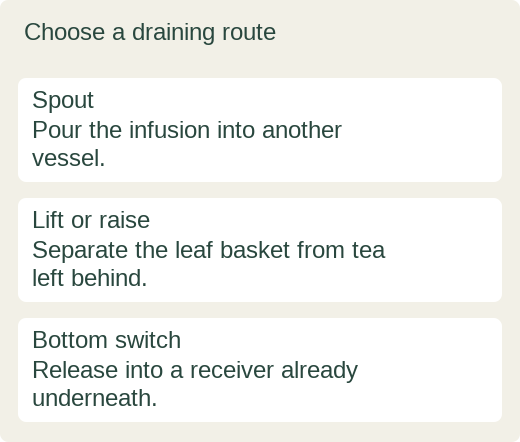
The question is how you will get the intended infusion away from the leaves. A lid-filter pot retains loose leaves while you pour the drink into another vessel. A basket design lifts or raises the leaves away from tea left in the pot or mug. A LARGO35 keeps water in its upper bowl until its base switch is pressed, then releases downward into a receiver.
On a phone, scroll within the table; keyboard users can focus the table region and use arrow keys.
| Design example | Endpoint operation | Extra arrangement |
|---|---|---|
| Rishi Simple Brew lid-filter pot | Fully decant through the lid strainer | A suitable receiving cup or pitcher |
| Hario Teaor Wood pull-up pot | Raise and secure the basket | The complete raising assembly and instructed lid control |
| Hario One Cup Tea Maker | Remove its tea strainer after the infusion | The lid can be flipped into a strainer tray as specified |
| Hario LARGO35 | Press the base switch to release to a receiver | A stable server or suitable dripper stand beneath it |
Prepare the receiver before water
The LARGO35 TDR-35B manual places the dripper on a stand or server before adding leaves and hot water. It cautions against carrying or touching the dripper once hot water is added, and against forcefully pressing the switch on a server because the dripper may fall. Those conditions belong in a buying decision, not just in cleanup notes.
The TDR-5012B server-set manual identifies practical capacities of 350 mL for the dripper and 450 mL for the server. These are attributed equipment capacities, not measurements of how much brewed tea reaches your cups. The actual receiver and permitted fill still need to match the intended operation. Do not assume any similarly sized drinking mug safely supports the dripper.
If your desk or serving station has no stable supported receiver arrangement, a bottom-release device may add a task you do not want. Compare that complete setup with a handled pot or removable mug basket rather than choosing only from the photograph of the upper bowl.
Follow the named switch workflow
- Check the exact assembled model and manual, including the ball, filter, holder, base and switch. The LARGO leak guide handles missing or incorrectly seated components.
- Place the dripper on the permitted stable server or stand before water. Have the receiver ready for the intended release.
- Add tea and water according to the tea’s directions and the equipment’s permitted method. The manual’s specific Japanese-tea starting examples are not universal recipes.
- Set the lid for the infusion as directed. At the chosen endpoint, press the switch gently to release into the prepared receiver.
- Handle and clean the equipment according to its instructions. Do not move a filled hot upper bowl around to solve a missing receiver.
A switch marks a release operation; it does not prove that every particle instantly stops extracting or that the drink will taste better than a decanted pot. Keep notable filling or drainage delays in a comparison record if timing matters.
Choose by the actual serving constraint
For tea you want to leave in a handled pot, a documented raised-basket mechanism can fit that endpoint. For a full decant into one cup, a lid-filter pot can avoid a bottom valve and its support arrangement. For a release into a waiting server, the switch dripper provides that route if you can follow its assembly and handling requirements.
These are operation choices. Comparing flavor requires the same clearly identified tea, complete methods and your actual observations. Manufacturer descriptions such as leaf expansion or a second cup as good as the first are not our comparative tasting results. Do not infer caffeine, strength or speed from a vessel’s nominal capacity.
Three workflow decisions
These fictional setups test the documented operations.
Case 1
A LARGO user adds hot water while no server or stand is ready, planning to carry it to a mug later. Is that the cited setup order?
Show answer and explanation for case 1
No. Prepare the permitted receiver/support arrangement before adding water.
The manual cautions against carrying the hot dripper. Its downward-release design requires a supported receiving route from the start.
Case 2
A reader wants the infusion to remain in a pot while the leaf basket leaves the drink. Which documented route matches that constraint?
Show answer and explanation for case 2
A suitable lift-out or raised-basket route, such as the described Teaor mechanism.
A lid-filter pot separates the serving drink by decanting, and a LARGO releases downward. The desired leaf/drink arrangement determines the route.
Case 3
The LARGO upper bowl is rated 350 mL and its set server 450 mL. Does that prove 350 mL will be served?
Show answer and explanation for case 3
No. They are practical equipment capacities.
Leaf retention, chosen water and drainage affect the actual serving. The capacity labels identify the setup without reporting a measured pour or taste result.
Keep the assembled instructions
Choose the route you can set up, operate and clean appropriately. Keep the exact model and manual with the brewer, including the correct server or stand information. If the device leaks or a required component is missing, resolve that assembly problem before another hot-water use.
Sources and further reading
- Tea Dripper LARGO 35|TEA|HARIO Co., Ltd.LARGO35 bottom-release mechanism, model capacities and parts. Checked November 11, 2026.
- Pull-up Tea Maker "Teaor Wood"|TEA|HARIO Co., Ltd.Named Teaor Wood parts and pull-up feature; TEO-45-OV glass-bowl permission. Checked November 11, 2026.
- How To Brew Loose Leaf Tea In A Simple Brew | Rishi TeaThe maker’s lid-filter brewing and full-decant sequence; no comparative tasting or universal spoon conversion. Checked November 11, 2026.
- One Cup Tea Maker|TEA|HARIO Co., Ltd.OTM lid/strainer removal before microwaving and lid-as-strainer-tray feature. Checked November 11, 2026.
- Hario LARGO35 TDR-35B: instruction manualLARGO35 stand/server-first setup, complete ball/filter/holder/base/switch assembly, handling and care. Checked November 11, 2026.
- Hario LARGO35 TDR-5012B server set: instruction manualLARGO35 server-set capacities, complete component assembly and hot-dripper precautions. Checked November 11, 2026.