Practical guide
Loose Glass Teapot Lid: Normal Fit or the Wrong Lid?
Hario says its glass teapot and kyusu lids are designed to perch on the pot and may move a little. That differs from a visibly unstable wrong-size lid. Identify the matched model, inspect it while cool, and follow the stated lid-retention method; stop using damaged or uncertain pieces.
On this page
Identify the product and its expected fit
A little lid movement is not enough to diagnose a manufacturing fault. Hario’s FAQ says its glass teapot and kyusu lids are designed to perch rather than fit snugly. It also says a wrong-size lid can show a noticeable difference, such as unstable placement. That explanation is about those products, not every glass brewer on the market.
Find the pot’s exact model and the matching lid or supplied assembly. A replacement described only as “glass teapot lid” lacks the information needed to establish compatibility. Nominal pot volume is also not a lid-size specification. For example, the Cha Cha Kyusu Maru family includes 300, 450 and 700 mL practical-capacity models; the product page lists their dimensions separately.
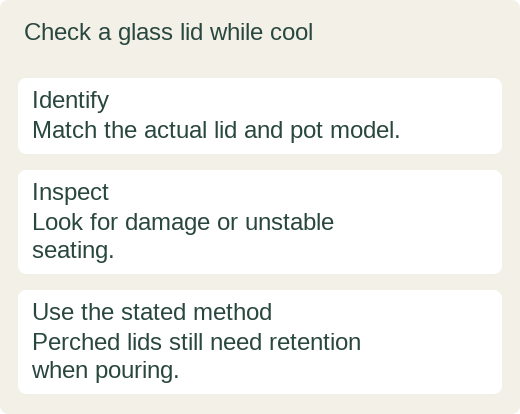
Inspect cold before a pour
- Leave the vessel empty and cool. Inspect the rim and lid for cracks, chips or other damage before considering fit.
- Confirm that the lid belongs to the pot, using the product label, order information or maker’s matching-part information.
- Place the matching lid according to the instructions and observe its seating on a stable surface. Separate a small permitted movement from a lid that will not perch reliably.
- If the lid appears mismatched, damaged or unstable, resolve the exact replacement with the maker before hot use. Do not test an uncertain lid by filling the pot with hotter water.
A cool inspection can reveal a mechanical mismatch; it does not certify that the contact points will stay cool or that you can control the same arrangement when hot. Use the exact handling guidance and an appropriate alternative when you cannot retain the assembly.
Separate normal movement from instability
On a phone, scroll within the table; keyboard users can focus the table region and use arrow keys.
| Observation | Documented distinction | Next step |
|---|---|---|
| Small movement of the intended perched glass lid | Can be part of Hario’s stated design | Retain the lid when pouring as directed |
| Noticeable unstable seating with a suspected wrong lid | FAQ identifies this as a possible mismatch | Identify and replace the correct matched part |
| Crack, chip or damaged rim | Not a normal-fit conclusion | Stop use and follow replacement guidance |
| Unknown make or unlabeled replacement | Hario FAQ does not establish its fit | Get the actual product’s instructions |
Do not glue, wedge or force an uncertain lid into position. That would change the assembly without a documented method for food contact, heat or pouring. A rattling sound alone is less useful than the actual identity, condition and seating of the two parts.
Compare hinged and perched mechanisms
Hario’s CLEAR BREW POT is a separate design: the maker describes a hinged lid arrangement that permits pouring without holding the lid. Its specification includes stainless-steel lid and strainer plus polypropylene hinge parts. That documented feature does not make its components interchangeable with a perched glass-lid kyusu.
If holding a lid while pouring does not suit your task, choose a documented mechanism you can use appropriately. A feature claim is not our physical handling test or a guarantee for every user. Compare the whole brewer and its instructions rather than buying an unrelated lid to imitate another design.
Documented details: [2].
Three fit decisions
These are invented observations for checking the published distinctions.
Case 1
An identified Hario glass-lid kyusu has a little lid movement, without visible damage or instability. Does that alone prove the lid is wrong?
Show answer and explanation for case 1
No. The FAQ describes some movement in the intended perched design.
Check the matched model and follow lid retention when pouring. The documented normal movement does not waive condition checks or guarantee hot handling.
Case 2
A spare lid from another pot sits visibly unstable. May equal advertised capacity establish a correct match?
Show answer and explanation for case 2
No. Resolve the exact matching part before hot use.
Volume is not a compatibility declaration. Hario identifies noticeable instability as a possible wrong-size sign; it should not be covered over with a guessed fit.
Case 3
A reader wants CLEAR BREW POT’s no-lid-holding feature on a glass-lid kyusu. Is replacing only the lid a documented conversion?
Show answer and explanation for case 3
No. These are separate complete mechanisms.
The hinged pot includes its own lid and hinge assembly. Neither its product description nor the perched-lid FAQ authorizes a cross-model conversion.
Stop and resolve the matched part
Keep the exact model, matching-part information and a clear description of the cool seating problem. Use the maker’s own replacement or support route if identity remains uncertain. A controlled pour depends on the whole assembly; solving the correct-part question comes before another hot-water trial.
Sources and further reading
- Cha Cha Kyusu Maru|TEA|HARIO Co., Ltd.CHJMN named capacities, dimensions, materials and strainer removal before microwaving. Checked November 11, 2026.
- CLEAR BREW POT|TEA|HARIO Co., Ltd.CLEAR BREW POT hinged lid mechanism and pot-only microwave boundary. Checked November 11, 2026.
- Hario FAQ: The lid does not fit properlyThe specific FAQ question named above, read with its full answer; category wording is not a universal model permission. Checked November 11, 2026.