Practical guide
Microwaving a Glass Teapot: Check and Remove the Right Parts
Check the exact brewer’s instructions before reheating tea. Hario’s named glass brewers have different removal rules: some remove lid and strainer, some remove the strainer, and some permit only the glass pot or server. Permission for one part does not authorize the assembled vessel.
On this page
Read permission for the whole named assembly
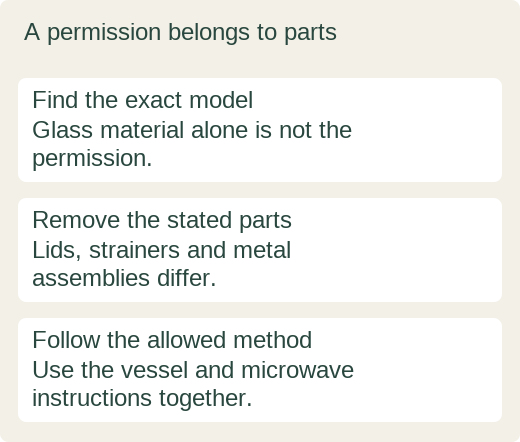
A product can have a heatproof-glass body and still have components that must be removed before microwaving. Identify the full model and the exact component rule. The word “glass,” a general capacity or a photograph of a tea mug does not establish how the assembled product may be heated.
The table below uses explicit instructions from Hario’s current English product pages, checked November 11, 2026. Read the precise model and component statement alongside your supplied manual before choosing the configuration to reheat.
Compare the model-specific removal rules
On a phone, scroll within the table; keyboard users can focus the table region and use arrow keys.
| Named model or family | Explicit removal or permitted-part statement | Do not silently add permission for |
|---|---|---|
| One Cup Tea Maker OTM-1NW / OTM-1B | Remove the lid and tea strainer before microwaving | The polypropylene lid or strainer |
| Cha Cha Kyusu Maru CHJMN family | Remove the tea strainer before microwaving | The stainless-steel strainer |
| CLEAR BREW POT TPF-60-HSV | Only the pot; remove lid and strainer | Its lid, strainer or hinge assembly |
| Tea Server Simply TS-45-HSV / TS-70-HSV | Only the glass server | Steel spout/filter and seal assembly |
| Tea Pot V TPV-45-T / TPV-45-TB | Only the pot | The complete lid-and-strainer assembly |
Read “only the pot” as a boundary, rather than trying to extend it because another piece also looks like glass. If the product’s supplied instructions give an additional limit or differ from a page, resolve that difference with the maker before use. This is a documented comparison, not an inspection or approval of your particular vessel.
Keep ovens and direct flames separate
Microwave permission does not establish oven, stovetop or induction permission. Those are different intended uses. Teaor Wood’s manual, for example, explicitly says not to expose that product to direct flame. Do not move a brewing pot onto a burner because a glass part is permitted in a microwave on another model.
A kettle that heats water and a brewer that receives prepared water are separate objects. Check the instructions for the actual object and heat source. Likewise, do not apply a metal-parts removal rule from one Hario model to every other manufacturer’s vessel; the complete intended assembly is what matters.
Documented details: [6].
Choose a complete allowed reheating method
- Identify the model and locate its explicit reheating instructions. If permission or the part boundary is unclear, use a different vessel with clear instructions rather than guessing.
- Let the equipment be handled appropriately, and inspect it for damage. The Teaor manual prohibits using cracked, chipped or highly scratched glass; an intact-looking material name is not an inspection result.
- Remove the components that the exact model’s directions require. Use its designed removal method; do not dismantle a fixed handle or force an unfamiliar fitting.
- Follow the vessel’s and microwave’s stated method, fill and handling limits. This guide does not supply a universal power setting or heating time.
- Handle the heated drink according to those instructions, then reassemble the brewer only in its permitted configuration for the next use.
If you instead transfer the drink to an explicitly suitable vessel, check that receiver’s own instructions. Transferring tea changes the container; it does not eliminate the need for a complete allowed method.
Three part-permission decisions
These fictional situations check the published wording; they are not reheating tests.
Case 1
The One Cup Tea Maker has a glass cup with a polypropylene lid and basket. Does the glass cup permit microwaving the complete set?
Show answer and explanation for case 1
No. Its page says to remove both lid and strainer.
The permission boundary belongs to the identified model and parts. A glass cup does not supply permission for the attached components.
Case 2
A Tea Pot V owner sees that its lid is glass. May that override the statement that only the pot is microwave-safe?
Show answer and explanation for case 2
No. Follow the published only-the-pot boundary.
Material and permission are different fields. Do not infer a permitted assembled configuration from a separate material description.
Case 3
A microwave-capable glass brewer is placed on a stovetop burner. Is microwave permission enough for that change?
Show answer and explanation for case 3
No. Obtain explicit permission for the actual heat source and product.
A heating method is not interchangeable with another. The cited Teaor manual explicitly excludes direct flame, and a different microwave rule does not override that instruction.
Check the actual instructions before use
Keep the model number, permitted component and required removals together. The useful result is a clear configuration you can follow, not a general promise about glass. If the supplied manual, model or condition remains uncertain, resolve it before reheating.
Sources and further reading
- One Cup Tea Maker|TEA|HARIO Co., Ltd.OTM lid/strainer removal before microwaving and lid-as-strainer-tray feature. Checked November 11, 2026.
- Cha Cha Kyusu Maru|TEA|HARIO Co., Ltd.CHJMN named capacities, dimensions, materials and strainer removal before microwaving. Checked November 11, 2026.
- CLEAR BREW POT|TEA|HARIO Co., Ltd.CLEAR BREW POT hinged lid mechanism and pot-only microwave boundary. Checked November 11, 2026.
- Tea Server Simply|TEA|HARIO Co., Ltd.Tea Server Simply steel/seal assembly and glass-server-only microwave boundary. Checked November 11, 2026.
- Tea Pot V|TEA|HARIO Co., Ltd.Tea Pot V parts and pot-only microwave boundary, including its separate glass lid. Checked November 11, 2026.
- Hario Teaor Wood: instruction manualTeaor Wood assembly pp. 4–6, handling p. 8, glass care p. 10, metal care p. 11 and wood care p. 12. Checked November 11, 2026.