Western Brewing vs Gongfu: Choose a Useful Workflow
Revised · Tea preparation, selection and tasting
Choose the brewing workflow that fits the drink and attention you want. A mug or pot can make one convenient serving; a short-infusion setup lets you attend to successive pours. Neither method automatically wins on quality, cost or authenticity, and a vessel name alone does not define the recipe.
Define the two workflows before comparing them
Here, “Western brewing” means a mug or pot preparation that commonly produces one larger serving from a timed infusion before separating the leaves. “Gongfu” means a skillful short-infusion workflow, commonly with a smaller vessel, a higher leaf-to-water loading and successive decanted pours. These are useful working descriptions, not fixed rules for every tea tradition or vessel.
Rishi’s Simple Brew instructions describe preparing a pot with the exact tea’s directions and fully decanting. Its Gongfu Cha article describes multiple short infusions using a gaiwan or small pot, a receiver and small cups. A handled pot can therefore appear in either workflow. Merely replacing a mug with a gaiwan does not establish dose, temperature or time.
Start with the task and the attention available
On a narrow screen, scroll this table sideways to read all columns.
| Your task | A useful starting workflow | Check before committing |
|---|---|---|
| One mug while working | A bag or removable infuser, or a pot decanted into a mug | Can you remove the tea at the intended endpoint? |
| Notice how one tea changes across pours | A product-appropriate short-infusion setup | Can you attend to filling, timing and decanting each round? |
| Serve several guests once | A suitably sized pot and receiving arrangement | Actual served volume, ingredients and guest preferences |
| Offer small successive tasting portions | A small brewer, receiver and labelled rounds | Enough liquid for each planned portion and an option to stop |
| Limited hand control or awkward setup | An appropriate stable handled brewer | Equipment instructions and comfortable handling, rather than a style label |
Choose the exact product’s directions for the selected method. Some suppliers publish separate mug and gongfu instructions. If only a mug recipe is available, it is more reliable to start with that complete method than to invent a short-infusion recipe from the title “oolong” or “premium.”
Compare dose and water on an explicit basis
Leaf amount is not meaningful without the water amount. For a defined dry-leaf/new-water calculation, grams per 100 mL = dry grams ÷ new water in mL × 100. Use the stated denominator and do not substitute the bowl’s rim capacity. The gaiwan capacity worksheet explains why nominal, rim, working and actual added-water amounts differ.
Consider fictional preparations of 3 g with 250 mL new water and 5 g with 100 mL. They equal 1.2 g/100 mL and 5 g/100 mL respectively. Those are arithmetic examples, not recipes, caffeine estimates or a promise about flavour. They illustrate why copying a several-minute mug time into a much more heavily loaded small vessel changes more than the vessel.
For later pours, retain the original dry-leaf amount in your session record and record the new water for each round. The leaves are already wet and have prior extraction history. A wet mass is not a newly measured dry dose.
Count actual handling and attention
A mug workflow still needs an endpoint: the bag comes out, the basket lifts out, or the pot decants. A long timer does not mean you can forget the tea indefinitely. Have a place for the wet leaves and use safe hot-liquid handling.
A short-infusion workflow commonly repeats preparation, filling, timing, decanting, portioning and deciding on another round. Those tasks take attention beyond the nominal steep seconds. Prepare the receiver and cups before the first pour. If you are constantly interrupted, a simpler workflow may produce a more repeatable cup than an elaborate setup you cannot attend to.
Choose equipment you can actually use: a stable surface, a food-use brewer and filter, a receiver with enough capacity, and a safe water source. Follow the maker’s guidance. A cold-water gaiwan rehearsal checks control but cannot establish comfortable hot handling.
Separate serving volume from the brewer label
Count the liquid decanted and the portions you serve. A 100 mL label does not mean exactly 100 mL arrives in cups after leaves and residual water. For three hypothetical 25 mL portions, 75 mL of served liquid is needed; whether your pour supplies it depends on the actual setup. Plan a permitted smaller portion or an appropriate larger brewer when necessary.
Do not compare a mug’s full served volume with only one tiny tasting portion and call the latter intrinsically cheaper. Reusing the same leaves for another infusion does not add a second dry-leaf charge, but adding fresh leaves does. The session-cost worksheet makes the accounting and serving denominator explicit.
Know what a comparison can tell you
If you brew the same product by two complete methods, you can ask “Which resulting serving do I prefer for this task?” That is a useful preference comparison even though dose, water, time and vessel differ. It does not isolate a single cause or prove that one entire brewing tradition is superior.
For a controlled first-infusion question, use fresh matched portions and change one recorded variable while keeping the rest as similar as practical. For successive infusions, use the same original leaves and record their history. Do not label infusion two as a repeat of infusion one with only time changed. The brewing log explains that distinction.
Include cleaning and the end of the session
A smaller brewer does not automatically mean less cleanup if you also use a pitcher, several cups and a tray. Conversely, a pot-and-mug method still requires cleaning its filter and removing spent leaves. Check washing, drying and storage instructions for the actual equipment, including parts that are not dishwasher suitable.
There is no required infusion count. Stop when another serving is not wanted or when the task, time or product no longer supports another round. Returning to a convenient mug tomorrow does not undo today’s observations from a short-infusion session.
Make a one-line decision you can revisit
Write the task, chosen product, available directions and why the workflow fits. For example: “One desk mug; this product has complete mug directions; removable basket prepared.” Or: “An attended tasting of one product; separate short-infusion directions available; receiver and portion plan ready.” These are decision structures, not tested tea recipes.
After the session, keep one practical observation about attention, handling, serving or cleanup. Improve that task before buying more equipment. The most useful method is the one you can carry out deliberately and repeat when you want the same kind of serving.
Choose a brewing method from the task
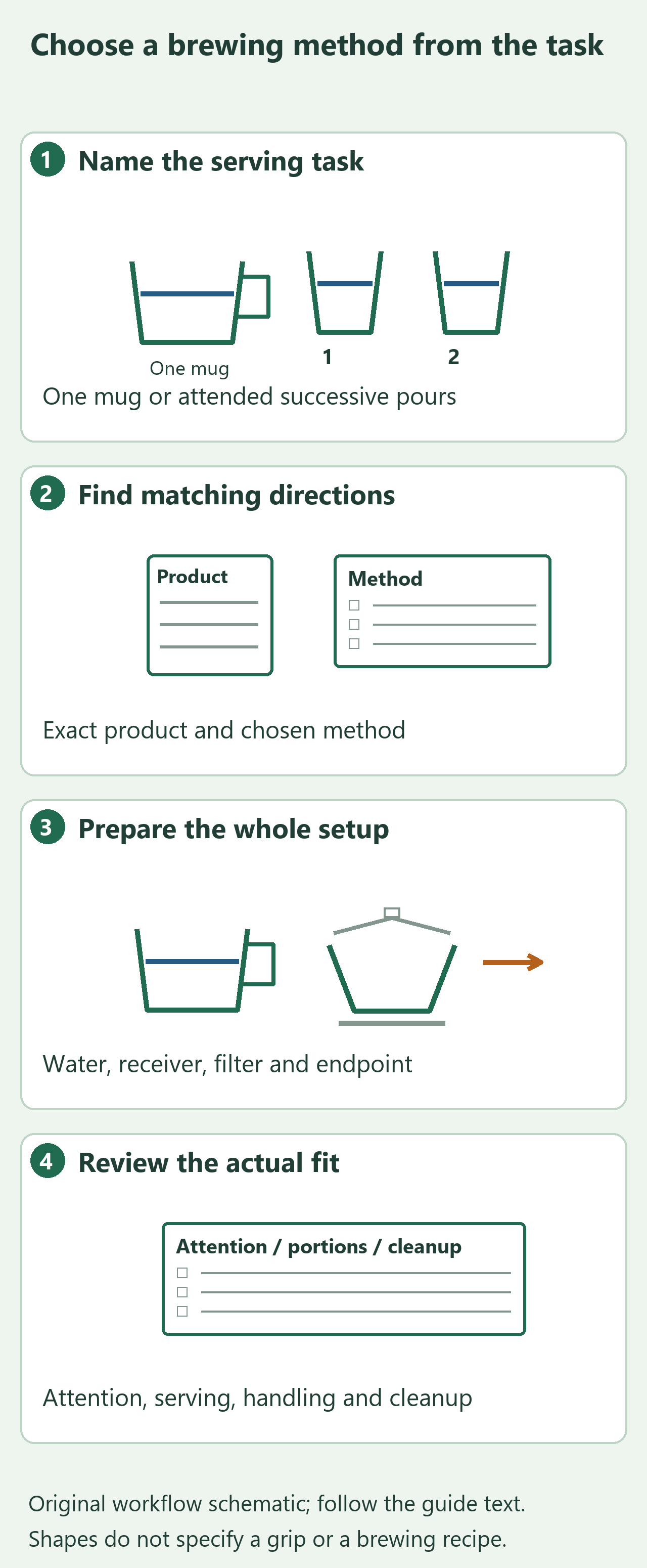
Examples to work through
These fictional examples illustrate practical choices and observations.
A desk drinker wants to try gongfu during a busy call
Repeated filling and decanting may not fit the available attention. Choose a complete mug method for the call, then reserve a short-infusion comparison for an attended session. Simpler handling can be the useful task match.
A mug time is copied into a heavily loaded gaiwan
The preparation changed dose, water and vessel as well as method. Return to product-specific directions for the chosen workflow. The fictional ratio calculation is not a licence to transplant the original timer duration.
One small pour must supply several guests
Calculate the intended portions from actual served liquid, not the brewer’s rim label. Prepare an appropriate receiver and portion plan, or choose a suitable larger workflow. The number of cups pictured with a set proves no serving quantity.
A reader prefers the gongfu serving of one product
That is a valid preference for the resulting serving and task. Because the complete preparations differ, it does not isolate the vessel as the sole cause or establish superiority for every tea, reader or occasion.
Brewing workflow decision sheet
Use these optional reminders to mark fields you want to keep in your own notes. The downloadable blank sheet contains every record field. Keep your completed record in your own appropriate private place.
Frequently asked questions
Is gongfu always better than a mug?
Choose by the task, product directions, handling and attention available. Successive pours can answer an attended tasting question; a mug can suit an everyday serving. A preference from one comparison is not a universal quality ranking.
Does gongfu require a gaiwan?
Rishi describes a gaiwan or small teapot. Select a suitable brewer you can use and decant reliably, then follow directions for that workflow. A vessel name alone does not define dose, water, temperature or time.
Can I keep the same dose and time when changing methods?
Do not assume so. Consult the actual product’s method-specific directions and define the water amount. A change in vessel, leaf loading and serving workflow can alter several preparation conditions at once.
Is the second infusion a fair first-cup comparison?
It has already-used leaves and their prior water-contact history. Use fresh matched portions for a first-infusion comparison. Use a successive-infusion record when the question is how the same leaves change across rounds.
Sources and what they support
- Rishi Tea: Simple Brew instructions
The maker’s pot workflow and instruction to follow the exact tea’s dose, temperature and time, then decant fully. Its own vessel quantities are not universal mug recipes.
- Rishi Tea: Gongfu Cha
A gaiwan or small pot, receiver, cups and successive short infusions. It does not supply one recipe or a detailed grip for every set.
- UK Tea & Infusions Association: making a brew
General preparation, packet instructions, leaf separation and storage. Its category suggestions are references, not recipes for every product.
Sources were checked on 4 November 2026. Seller specifications are attributed to the seller. Check current product and equipment instructions before use or purchase. The planning sheets, hypothetical calculations and scenarios are original editorial aids; they are not product tests or measured tasting results.