Practical guide
Loose-Leaf Tea Cost per Session: Including Multiple Infusions
Calculate the whole session before dividing by actual infusions or measured drink. Count fresh leaf additions, separate purchase cash from used stock, and use an original budget record, four-step diagram and eight explained examples. All monetary inputs are clearly fictional.
Calculate the leaf cost of the whole session first
Tea-only session cost = pack price ÷ net dry tea grams × total new dry grams used in that session. When you infuse the same leaves again, you have not bought or used another fresh portion. Further infusions can provide more drink from that portion, but they do not divide the total session expense. Divide later only if you want an explicitly named cost per infusion, person or measured drink volume.
For a fictional USD 20 pack containing 100 g, the rate is USD 0.20 per gram. A session starting with 5 g costs USD 1 in tea. One infusion and four infusions both allocate USD 1 to the whole session when no more fresh leaf is added. The four-infusion average is USD 0.25 per infusion, not USD 0.25 for the session.
This guide supplies original arithmetic and a budget record. Every monetary example is invented and describes no named product or tasting trial. Replace the inputs with your current package, receipt and recorded use. Start with a tea-only calculation, then show additional costs separately so the comparison stays understandable.
Read the net quantity and the price basis
Use the net quantity of dry tea, excluding a tin, outer gift box, scoop or brewing vessel. Convert kilograms to grams before dividing: an illustrative 0.1 kg means 100 g. For another mass unit, keep the conversion visible and use the same unit for both pack quantity and dose. A cup estimate on a listing is not a substitute for net mass because cup size and preparation amount can differ.
Use the actual price after an applicable discount, in one currency. State whether tax, delivery or a necessary accessory is included. Do not compare one pack with delivery included against another tea-only price while describing both as the same cost basis. If a bundle includes equipment and has no reliable tea-only price, record the total bundle expense separately rather than declaring the pictured accessory free.
For samplers, a list of twelve named teas does not establish equal weights. Without quantities for the individual selections and a defensible price allocation, the pack total cannot establish a precise per-tea gram price. The gift sampler checklist explains distinct teas, pieces and selected accessory options. That selection task is separate from the actual session arithmetic here.
Different packages can have different per-gram prices. Keep the exact product, size, date and price basis beside the result. Do not treat a high price as evidence of superior taste or a lower one as proof of poor tea. The calculation answers a spending question, not a quality or health question.
Count new dry leaf, including later additions
Weigh the dry portion in grams before brewing if you want a gram-based cost. A teaspoon measures volume, and different leaves or packing can have different masses. Neither the Canadian brewing overview nor the Rishi method provides a universal teaspoon-to-gram conversion for every tea. If you have not measured mass or obtained a product-specific equivalence, leave the gram cost unresolved rather than inserting a convenient number.
Retain the original dry mass through later infusions. Wet leaves contain water and are not another dry dose. In a session that starts with 5 g and later receives 2 g of fresh leaf from the same USD 0.20/g pack, the new dry mass is 7 g and the tea cost is USD 1.40. Water-only top-ups add no leaf charge. If fresh additions come from another pack, multiply each new portion by its own rate and add the results.
Define where your session begins and ends for the record. A fresh portion used later that day is another consumption entry; call it another session or an additional portion consistently. The label does not change how many new grams left the pack. A grandpa-style routine with occasional additions especially needs that distinction.
Use appropriate directions for the actual tea, vessel and method. Rishi notes that many loose-leaf teas can be infused more than once and points to product-specific directions. It does not guarantee three, five or ten worthwhile infusions for every tea. Do not force another steep, increase leaf use or finish unwanted drink merely to make a calculated unit cost look smaller.
Name the denominator when comparing infusions and cups
| Situation | Recorded inputs | Calculated leaf cost | Interpretation |
|---|---|---|---|
| One loose-leaf session | USD 20 / 100 g; 5 g new dry leaf | USD 1.00 for the session | Two, four or no further infusions do not change the original leaf charge. |
| Fresh leaf added later | Same price; 5 g initially + 2 g fresh later | USD 1.40 for the session | Include both new dry portions; water-only top-ups add no leaf cost. |
| Four actual pours | USD 1 session; 4 pours of 150 mL served | USD 0.25 per pour; about USD 0.167 per 100 mL served | The total remains USD 1; use the observed 600 mL, not advertised vessel capacity. |
| Only 500 mL drunk | Same USD 1 session; 500 mL actually drunk | USD 0.20 per 100 mL drunk | Served and drunk volume answer different questions. Name your denominator. |
| A different small pack | USD 14 / 50 g; 4 g new dry leaf | USD 1.12 for the session | These invented prices are arithmetic inputs, not checked shop prices or a quality ranking. |
“Cost per cup” is incomplete unless the cup is defined. One 150 mL pour and one 350 mL mug are different quantities. For a measured volume comparison, use session leaf cost ÷ actual volume × 100 and label the result per 100 mL served or per 100 mL actually drunk. Newly added water and a vessel’s empty capacity are not necessarily the liquid served; the gaiwan measurement worksheet separates those quantities.
A four-pour session costing USD 1 and serving 600 mL averages about USD 0.167 per 100 mL served. If only 500 mL is drunk, it averages USD 0.20 per 100 mL drunk. Keep the distinction instead of using the larger served figure to describe drinking cost. Record missing volume as unknown; a useful session cost does not require an invented exact cup volume.
For a fair numerical comparison with bags, set the same volume basis and count each fresh bag actually used. In one invented 400 mL example, loose leaf costs USD 1 and two USD 0.30 bags cost USD 0.60: USD 0.25 and USD 0.15 per 100 mL served. This says nothing universal about taste, strength, convenience or extraction. Your products and routine can produce a different result.
Splitting USD 1 equally between two drinkers gives USD 0.50 each only on that stated equal-sharing basis. If servings are unequal, choose and name an allocation that fits the question. Do not quietly compare per-person cost from a shared pot with per-session cost for a person drinking alone.
Keep session cost and unit cost visible together
The four-step diagram keeps purchased mass, new dry dose and any later denominator distinct. Save the total before dividing it. This lets a budget count sessions while a serving comparison counts measured drink.
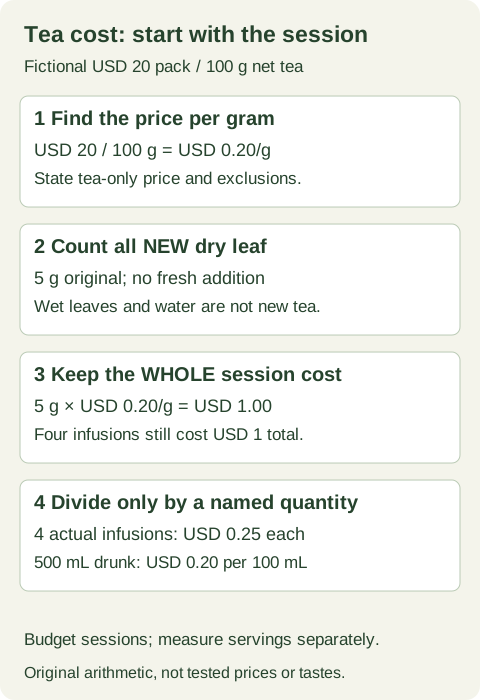
Retain enough decimal places during the calculation, then round the displayed money result. USD 14 divided by 50 g is USD 0.28/g; a 4 g portion costs USD 1.12. USD 20 divided by 90 usable grams is a repeating decimal; rounding the per-gram rate early can distort several sessions. An approximate home leaf weight also does not justify reporting a result to five decimal places.
Zero or unknown pack mass cannot support a per-gram calculation. Zero observed drink volume cannot support a per-volume cost. A session stopped before any drink was served can still have used and incurred a charge for its leaf; do not delete that consumption simply because there is no cup denominator.
Account for remaining stock and recorded losses
Whole-session count is the complete portions that fit the remaining dry mass. With 17 g left and a chosen 5 g portion, three complete sessions fit and 2 g remain. At USD 0.20/g, those sessions allocate USD 3 and the remainder carries USD 0.40. The 2 g does not disappear because the session count is rounded down. Decide how it fits a later suitable preparation, or record a real loss separately.
You can use a purchased-gram basis with losses recorded separately, or spread the price over usable grams. An invented USD 20/100 g pack with a recorded 10 g spill leaves 90 usable grams: USD 20 ÷ 90 × 5 gives about USD 1.11 per 5 g session on that basis. Do not also add the same spill charge to that adjusted rate; that would count the loss twice.
A larger pack can lower the purchased-gram rate while increasing cash tied up in stock. In a fictional comparison, USD 50/250 g is USD 0.20/g, while USD 14/50 g is USD 0.28/g. If you use 50 g from the large pack and keep the remaining 200 g usable, USD 10 is allocated to used tea and USD 40 remains in inventory. Paying USD 50 now is still a larger cash purchase than paying USD 14.
If that entire 200 g remainder is ultimately discarded, the same USD 50 spread over only 50 g used gives USD 1/g. This is a deliberately hypothetical loss scenario, not a prediction of shelf life or a recommendation to discard tea. Choose package size around a realistic use rate, follow the actual storage directions and keep known stock separate from future assumptions.
Build a monthly tea budget from sessions and purchases
| Field | Your record | Example |
|---|---|---|
| Tea and pack | Exact product / net dry mass / currency | Fictional Pack A / 100 g / USD |
| Price basis | Tea-only price actually paid; exclusions | USD 20; no discount, tax or delivery in this example |
| Session leaf | Total new dry grams, including additions | 5 g; no additional fresh leaf |
| Planned sessions | Number in the period; realistic use | 20 sessions; frequency is a planning choice |
| Allocated leaf cost | Price / pack grams × grams/session × sessions | 20 / 100 × 5 × 20 = USD 20 |
| Purchase cash and stock | Packs bought / other charges / closing grams | One USD 20 pack + USD 4 delivery = USD 24 cash; 0 g left |
| Actual review | Sessions / new dry grams / stock / differences | Fill after use; retain missing values and leftover stock |
Choose a period and a realistic number of sessions. Multiply session leaf cost by that count for an allocated tea-use budget. An invented 20-session month at USD 1 per session allocates USD 20 of tea; a USD 16 tea-only allowance covers sixteen such whole sessions. Repeated infusions may increase the number of pours, but do not double the number of funded sessions.
Keep purchase cash alongside allocated use. If you already own sufficient tea, current-month cash spending can be zero while you consume previously paid-for stock. If you purchase a large pack now but use it over several months, this month’s cash outflow exceeds this month’s allocated leaf use. Neither number is wrong; they answer different planning questions.
Record tax, delivery, milk or other additions when those expenses belong in your budget. Teaware is a separate purchase; spreading its price over an assumed lifetime of sessions is an optional allocation that must state that assumption. Do not present an imagined vessel lifetime or electricity cost as a measured saving.
Download the session, inventory and monthly budget record. It contains blank fields, the worked arithmetic and all eight explained cases. Compare planned and actual new dry grams at the end of the period. Update the next budget from observed use rather than a promised infusion yield. For recording the successive preparation itself, use the multiple-infusion tasting sheet; it keeps leaf history and cup observations separate from this spending record.
Eight original checks before comparing a tea budget
These fictional cases test units, new leaf, repeated infusions, stock and price allocation. They are arithmetic exercises, not shop quotations, product trials or a recommendation to choose a tea by price alone.
Case 1
A fictional pack costs USD 20 for 100 g. You use 5 g and infuse those same leaves four times. Is the tea-only cost of the whole session USD 0.25?
Show answer and explanation for case 1
No. The session costs USD 1.00; USD 0.25 is the cost per infusion when there are four.
20 / 100 = USD 0.20 per gram; 5 × 0.20 = USD 1.00. Divide by four only when reporting a per-infusion average. Reused leaves do not become four separate fresh doses, and the whole session charge does not shrink.
Case 2
At USD 0.20 per gram, you start with 5 g, top up water, then add 2 g of fresh dry tea. Which leaf mass belongs in the session cost?
Show answer and explanation for case 2
7 g of new dry leaf, giving USD 1.40.
Count the original portion and the intentional fresh addition. A water-only top-up adds no dry tea. If the later leaves come from a different pack, calculate the two portions at their own per-gram prices and add their costs.
Case 3
A USD 1 session gives four 150 mL pours. You drink 500 mL in total. What is the leaf cost per 100 mL actually drunk?
Show answer and explanation for case 3
USD 0.20 per 100 mL drunk.
1 / 500 × 100 = 0.20. The 600 mL served would give about USD 0.167 per 100 mL served instead. Both calculations can be valid, but the denominator must state which quantity was observed; do not mix them.
Case 4
You have 17 g remaining at USD 0.20 per gram, and your chosen session uses 5 g. How many complete sessions fit, and does the remainder have no cost?
Show answer and explanation for case 4
Three complete sessions fit, with 2 g left carrying USD 0.40 of allocated leaf cost.
17 = 3 × 5 + 2. The USD 3 used in three complete sessions and USD 0.40 remaining account for the USD 3.40 stock value. Use the remainder appropriately or record any loss; rounding down the session count does not erase inventory.
Case 5
An invented 100 g pack costs USD 20, but a recorded spill leaves only 90 g usable. If you spread the pack price over usable leaf, what is the cost of a 5 g session?
Show answer and explanation for case 5
About USD 1.11, on the usable-leaf allocation basis.
20 / 90 × 5 = 1.111… . Keep extra decimal places until the final result. Alternatively retain the purchased-gram basis and record the spill separately. Do not inflate the per-gram rate and also charge the same lost leaf again.
Case 6
An invented 250 g pack costs USD 50 and a 50 g pack costs USD 14. Does the larger pack guarantee a lower cost for the tea you actually drink?
Show answer and explanation for case 6
No. Its lower purchased-gram rate depends on what happens to the unused stock.
The rates are USD 0.20/g and USD 0.28/g. If only 50 g of the large pack is used and all the remainder is ultimately discarded, spreading USD 50 over the 50 g actually used gives USD 1/g. That is a fictional loss scenario, not a normal shelf-life assumption or advice to discard tea.
Case 7
For the same 400 mL served, an invented loose-leaf session costs USD 1.00. Two fresh bags cost USD 0.30 each. What does this example establish?
Show answer and explanation for case 7
USD 0.25 versus USD 0.15 per 100 mL served for these stated inputs.
1 / 400 × 100 = 0.25; (2 × 0.30) / 400 × 100 = 0.15. It does not establish that bags are always cheaper, equally strong, equally pleasant or appropriate for the same preparation. Compare your actual products, quantities and method.
Case 8
Your fictional tea-only budget is USD 16, and the chosen session costs USD 1. Each session happens to include two infusions. Does that fund 32 sessions?
Show answer and explanation for case 8
No. It funds 16 whole sessions under those assumptions.
16 / 1 = 16 sessions. The sequence may supply 32 infusions if each of those 16 sessions actually has two, but infusion count is a different unit. Delivery, tax, accessories and changes in dose need separate budget entries.
Sources and further reading
- Tea and Herbal Association of Canada: How to BrewTea amount, temperature, contact time and separating leaves from the drink. Its teaspoon advice is not converted to one universal gram mass.
- Rishi Tea: How to Brew Loose Leaf Tea in a Simple BrewFollow the particular tea and method instructions; many loose-leaf teas may be infused again. No fixed infusion count, universal recipe or equal strength is inferred.