Oolong Gongfu Session: Plan, Pour and Adjust
Revised · Tea preparation, selection and tasting
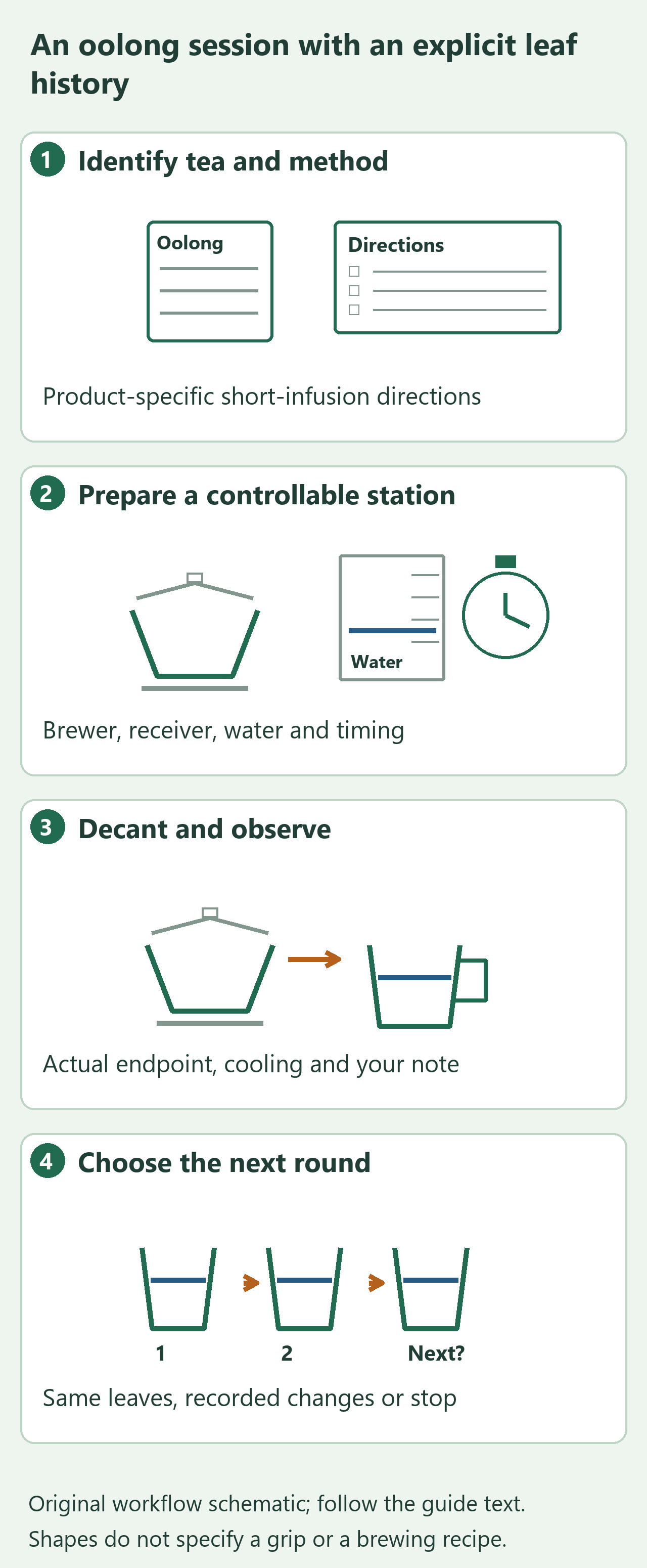
An oolong session starts with one identified product and instructions suited to short successive infusions. Prepare the brewer and receiver, define the water amount and timing, then decant each round deliberately. Leaf shape or roast language alone cannot provide the correct recipe.
Identify the oolong before choosing its preparation
Oolong is a partially oxidised tea category with varied styles and processing. UKTIA describes both rolled greenish examples and darker leafed examples; that variety is the reason to identify the actual product. A “light,” “roasted,” “rolled” or “rock tea” label may help describe a style, but it does not supply dose, water temperature or an infusion count.
Record the product name and supplier, full ingredients if it is scented or blended, and any supplied method-specific directions. Do not assign a temperature from leaf colour or promise a floral, mineral or roasted note before tasting. Supplier descriptions are useful selection information; observations in your own cup need their own record.
Find a complete short-infusion method
Look for dry-leaf amount, brewing-water amount, temperature, first-infusion timing and any later-infusion guidance together. Check the vessel and capacity basis used in the directions. If the product only supplies a mug recipe, start with that complete recipe or ask the supplier for suitable short-infusion guidance. This article does not turn an incomplete label into a verified universal oolong recipe.
Rishi’s Gongfu Cha article describes multiple short infusions and includes oolongs among the types used for repeated steeping. Its article does not provide one numerical recipe for all oolong, and we do not invent one on its behalf. Rishi’s separate Simple Brew guide likewise directs readers to the particular tea’s instructions.
On a narrow screen, scroll this table sideways to read all columns.
| Preparation field | What belongs in your plan | Keep separate |
|---|---|---|
| Dry tea | Original measured portion and product identity | Wet-leaf mass or a later addition of fresh leaves |
| Water | Actual new water intended for each infusion | Rim capacity, empty working reference and served liquid |
| Temperature | Product guidance plus your setting or measurement basis | A claimed exact in-vessel reading that was never taken |
| Timing | Start convention, planned contact and decanting endpoint | Fill delay, drainage delay and rest between rounds |
| Rinse or preheat | Only steps actually specified or intentionally chosen, with their purpose recorded | Assuming every oolong requires the same rinse |
Prepare a controllable station
Use a clean food-use gaiwan or small handled pot, drinking water and an appropriate hot-water source, a timer and a stable receiver. Add cups and any filter needed for the actual leaf. Check capacity, condition and care instructions for all pieces. A tray can be useful for a particular setup, but it does not replace a clear stable surface.
If using a gaiwan, follow the maker’s handling guidance and practise the mechanical pour with cool water first. The gaiwan use guide explains the limits of that rehearsal. If control or hot handling is unsuitable, choose an appropriate handled brewer. Changing to a suitable vessel is a practical decision, not a failed session.
Check that the receiver holds the intended decanted infusion. Plan portions from actual liquid served. If several people are tasting, ask whether they want a small portion or to skip a round, and have water available. Do not require anyone to finish every infusion or infer caffeine content from a delicate flavour.
Run infusion one from plan to endpoint
- Prepare the original portion: measure the dry leaf according to the product’s method. Keep the identity and dose visible in your notes.
- Complete any chosen preparation step: follow equipment guidance for preheating and record any product-specified rinse. A rinse contacts the leaves and belongs in their history.
- Add the defined new water: use the intended amount and temperature basis. Wet leaves and retained water affect later fills; do not equate a rim mark with measured new water.
- Time and decant: follow the stated convention or record a consistent one. At the endpoint, fully decant the infusion into the prepared receiver using safe controlled handling. Record meaningful interruptions.
- Cool and observe: taste when comfortable and write one observation of aroma, taste or mouthfeel in your own words. Record any additions or different serving conditions.
For a fictional record example, suppose an intended method used 5 g original dry leaves, 100 mL new water, a 95°C kettle setting and 20 seconds before starting the decant. If drainage then took 6 seconds, record both the planned 20 seconds and the observed drainage. These invented values illustrate a record; they are not a tested recipe or a recommendation for your oolong.
Choose the next round from the product and observation
Keep the same original leaves for a successive-infusion session unless you deliberately change the task. Follow supplied later-infusion directions, then use your observation to choose any recorded adjustment. New water, temperature basis, contact time, decanting and the gap between pours remain relevant.
There is no universal rule to add ten seconds after every round, use more heat because leaves are roasted, or finish a promised number of infusions. A product’s later-infusion instructions may guide a pattern, but stop when the next serving is not wanted or the setup no longer fits the task.
If one round is bitter or drying, check the actual endpoint and preparation against the plan. Adjusting the next round may be useful for that session, but it cannot demonstrate how a fresh first infusion would respond. If you want that comparison, start later with a fresh matched portion and change one recorded variable.
Handle three common interruptions deliberately
Leaf blocks the pour: set the vessel down safely before reassessing the gap or filter; do not force a hot lid while struggling to retain the bowl. The receiver is too small: resolve capacity before another infusion rather than interrupting a pour to find cups. A phone call delays decanting: record the actual delay and treat the result as that changed preparation.
If fresh leaves are added mid-session, note the added dry amount and that you now have a mixed leaf history. It is no longer the same original portion alone. Do not quietly count the resulting pours as unchanged consecutive infusions of the starting leaves.
Keep the session summary small
Write the product, original dry amount, chosen method, one preparation observation and one practical change for next time. For a fuller round-by-round record, use the multiple-infusion tasting worksheet. It already provides the detailed log; this guide helps you set up and run the oolong task around it.
Finish with the maker’s cleaning and drying process. A useful session can end after a few wanted rounds, after one handling lesson, or with a decision to prefer the product’s mug method. No flavour word or infusion count is required to validate your own observation.
An oolong session with an explicit leaf history
Examples to work through
These fictional examples illustrate practical choices and observations.
A roasted oolong only has mug directions
Use that complete method first or obtain suitable instructions for short successive infusions from the supplier. Roast language alone cannot supply a verified gaiwan dose, temperature or timing.
The planned endpoint is missed during a call
Record the actual decanting delay and the resulting observation. The cup came from longer leaf contact than planned. Resolve the attention problem before repeating the setup rather than claiming the intended duration was achieved.
A later round is better after a time adjustment
Keep the improvement as a useful session observation. Because those leaves had already been used, it does not isolate how time would change a fresh first infusion. Use fresh matched portions for that separate question.
More fresh leaves are added halfway through
Record the new dry dose and the mixed leaf history. Do not keep presenting the session as consecutive pours from the unchanged original portion. The next observation belongs to the deliberately altered preparation.
Oolong session setup and decision record
Use these optional reminders to mark fields you want to keep in your own notes. The downloadable blank sheet contains every record field. Keep your completed record in your own appropriate private place.
Frequently asked questions
Does every rolled oolong need boiling water?
Leaf shape alone does not establish the recipe. Follow the exact product’s instructions for the chosen method, including dose, water and time. Record the temperature basis you actually used rather than inventing a precise in-vessel reading.
Must I rinse oolong before infusion one?
Follow any product-specific directions and record the step if used. There is no universal rinse requirement established here. A rinse is water contact and belongs in the leaf history when you compare later infusions.
How many infusions should an oolong session have?
Use any actual product guidance and stop when another round is not wanted or no longer fits the task. A promised count is not a quality test, and nobody needs to finish all planned portions.
Can the next infusion test a shorter first steep?
It uses already-extracted leaves, so it answers a successive-infusion question. For a first-infusion comparison, use fresh matched portions and keep other conditions as similar as practical while changing one recorded variable.
Sources and what they support
- UK Tea & Infusions Association: types of tea
Broad green, black and oolong processing distinctions. We use the relevant descriptions; a category does not supply an exact product recipe.
- UK Tea & Infusions Association: tea varieties
Named tea styles, blends and scenting examples. The association’s descriptions do not guarantee the flavour of a particular packet.
- Rishi Tea: Gongfu Cha
A gaiwan or small pot, receiver, cups and successive short infusions. It does not supply one recipe or a detailed grip for every set.
- Rishi Tea: Simple Brew instructions
The maker’s pot workflow and instruction to follow the exact tea’s dose, temperature and time, then decant fully. Its own vessel quantities are not universal mug recipes.
Sources were checked on 4 November 2026. Seller specifications are attributed to the seller. Check current product and equipment instructions before use or purchase. The planning sheets, hypothetical calculations and scenarios are original editorial aids; they are not product tests or measured tasting results.