Practical guide
How to Plan a Multiple-Infusion Tea Tasting
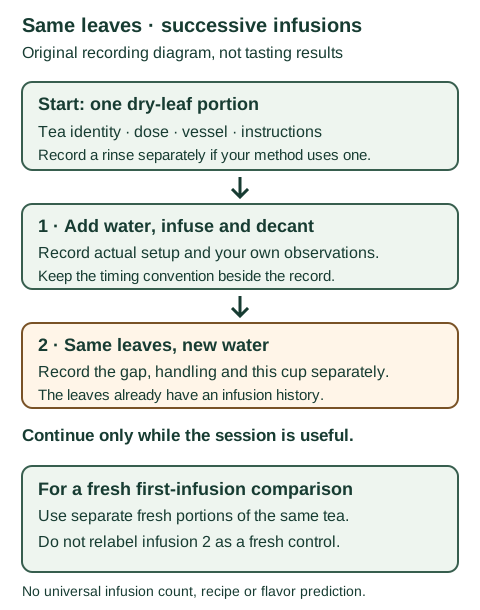
Follow one original leaf portion through successive infusions. Record each new water amount, temperature basis, timing, draining, gap and your own observations. Use a blank tasting sheet and a clearly fictional setup example; a later infusion is a changed leaf history, not a fresh first-infusion control.
Plan a sequence with one tea and one original leaf portion
A multiple-infusion tasting follows the same portion of leaves through successive additions of water. Give each infusion its own record. The purpose is to notice what happens in your session and make a useful next-brew decision, rather than to fill every row with impressive flavor words.
Choose one exact tea, the instructions for that product and a familiar vessel. Keep the session small enough to prepare and taste comfortably. You can stop when the cup no longer interests you or when you have enough notes. A three-row sheet is a convenient layout, not a promise that every tea gives three worthwhile infusions.
Rishi’s loose-leaf brewing guide says many loose-leaf teas can be infused more than once and notes that some product pages give specific later-steep directions. It also recommends checking the particular tea’s instructions, using a timer and fully decanting. Use those product directions where available; do not apply one temperature or time increment to every tea.
This sheet is for loose leaves infused with hot water and separated from the drink. Powdered tea that remains in the cup, cold-brew storage and comparisons between different products need different records. It is a home observation sheet, not a laboratory extraction study or a test of caffeine content.
Write the shared setup once, then record each change
At the top of the sheet, write the tea name, supplier and package or lot identifier if available. Note where the product’s instructions came from. Record the original dry leaf amount, with its unit, before the first infusion. Those same leaves remain the original portion in later rows; the mass of wet leaves is a different quantity.
Add the water source, vessel, strainer, lid and preheating routine. If a product method includes a rinse, record it separately: water amount, timing and whether it was discarded. A rinse is still part of the leaves’ preparation history. Calling the next drink “infusion 1” does not make those leaves identical to leaves that were never rinsed.
The Tea and Herbal Association of Canada’s brewing guide identifies temperature, tea amount and steep time as preparation details, and tells readers to strain or remove the leaves. A session header keeps these shared details visible without rewriting them in every row.
Choose a modest question: “What do I notice across successive infusions of this tea with this routine?” If you intentionally alter later timing, write the change. Your record can describe the entire sequence, even when it cannot isolate a single cause.
| Field | What to write | Why it matters |
|---|---|---|
| Infusion number | 1, 2, 3, or the actual number | Connect the row to the same original portion of leaves. |
| New water added | Actual amount and unit | Do not substitute the empty vessel’s rim capacity or the drink poured out. |
| Temperature and basis | Measured value and location, or kettle setting only | A kettle setting does not establish the temperature at the leaves. |
| Contact timer | Actual duration; timer start and stop convention | Keep a late start or missing measurement visible. |
| Draining | How you drained; approximate draining duration if observed | Starting the pour does not instantly end all water contact. |
| Gap before next water | Approximate interval and what happened to the leaves | Record a longer interruption instead of treating every row as the same routine. |
| Tasting conditions | Order, cooling stage and additions, including none | A very hot cup and a cooler cup can be different sensory experiences. |
| Your observations | A few sensations or associations you noticed | “Not noticed” and “no clear difference” are useful records. |
Keep the water amount, timer and gap understandable
Record the new water added in each row. A vessel’s advertised capacity does not tell you how much water reached that portion of leaves. Likewise, the liquid decanted into a cup is not necessarily identical to the amount added. The gaiwan capacity and dose guide explains these quantities separately.
Write temperature with a unit and a basis. “85°C kettle setting; water at leaves not measured” is more informative than “85°C” with no explanation. If you measure, identify where and when: in the kettle, during pouring or in the vessel. Do not invent a temperature correction for heat lost on the way.
Select a timer convention that you can repeat. One possible home convention is “start when the first water touches the leaves; stop when I start decanting.” Write the convention beside the table. If a supplier uses a different definition, follow it and record that definition. Keep unusually slow filling or draining visible because the leaves remain in contact with water during part of that handling.
Record the approximate gap between finishing one decant and adding the next water. “About 2 minutes; lid off” and “about 20 minutes during a phone call” describe different histories. If you did not check the interval, write “not measured.” Avoid holding the next hot pour while trying to complete a perfect sentence; simple notes can be expanded after the vessel is safely set down.
Fully decant according to the method you use, then keep the cups identifiable. If you mix an earlier cup with a later one, label the mixture rather than assigning the combined taste to either infusion. Small pours are enough for this record; finishing every cup is not a condition of a useful tasting.
A later infusion is a changed leaf history
If infusion 1 lasts 30 seconds and infusion 2 lasts 40 seconds, you have not changed only time. Infusion 2 starts with leaves that have already met hot water and released material into an earlier drink. Infusion number, prior handling and possibly the gap have changed too.
You can still write “infusion 2 seemed less bitter to me” when that is what you actually noticed at a similar cooling stage. What the record cannot establish is “adding 10 seconds caused less bitterness.” The sequence describes your cups under their recorded conditions; it is not a matched experiment isolating one variable.
For a first-infusion time comparison, use separate fresh portions from the same tea and keep the other planned conditions as steady as practical. Use the matched first-infusion brewing log for that task. If a rinse is part of the chosen method, give both portions the same recorded rinse routine rather than silently treating one differently.
Comparing two whole sessions is another possible question. State which original portions, methods and sequence lengths you used, and keep their rows separate. One session with a long interruption cannot silently replace an uninterrupted session as though the histories were identical. Neither kind of home comparison proves an ideal recipe for every tea drinker.
Describe what you noticed, not what a label told you to notice
Separate the setup from the cup description. A measured amount and a timed steep belong in the preparation fields. “Light body to me” belongs in the observation field. Write both, so a later reader can tell a recorded action from a personal impression.
Use a few words you understand. You do not need to identify flowers or fruits to write a useful note. A label saying “orchid and honey” is a supplier’s description until you notice an association yourself. You can keep that text in a separate “supplier description” field without copying it into your results.
| Aspect | Possible wording | Boundary |
|---|---|---|
| Aroma association | “Reminds me of toasted bread.” | An association is your description, not proof that bread or a particular chemical is present. |
| Bitterness | “A bitter edge while sipping.” | Keep taste separate from a drying mouth sensation. |
| Drying sensation | “My mouth feels gently drying after the sip.” | Do not automatically call every drying sensation bitter. |
| Body | “Feels light to me” or “more substantial than cup 1.” | Use the same meaning across your own rows; no score is required. |
| Finish | “The sensation fades quickly after swallowing.” | Describe what you noticed without inventing a duration. |
| Uncertainty | “No clear association” or “no clear difference.” | Blank or uncertain observations are better than copied flavor claims. |
These sentences are fictional wording examples. They describe no named product and no cup prepared by us. Use them as prompts, then replace them with your actual observations or leave the field blank.
Let each cup reach a comfortable tasting temperature. For a comparison across rows, use a similar cooling stage and note the order. A cup held for much longer can feel different from a newly poured cup. If you retain small samples for side-by-side tasting, identify them and note that the older sample has been standing longer. Do not claim temperature or standing time was controlled unless you actually controlled it.
Record additions, including none. Milk or sweetener added only to one row changes the drink you are describing. For a social tasting, let each person write a short note before discussing it if independent impressions matter to you. Agreement after a conversation is not evidence that every person noticed the same thing before discussion.
Use the blank sheet and a clearly fictional worked setup
Download the multiple-infusion tasting record. The editable text file contains a shared header, a reusable row, a three-infusion planning example, descriptor prompts and the six explained cases below. Print the file or edit a copy. The page’s print controls also provide the guide and practice answers.
The example below uses a fictional 4 g original dry portion and a fictional tea whose assumed chosen instructions fit these numbers. It demonstrates how to write the fields; it is not a tested product recipe or an instruction to use these settings for your tea. Timer convention: start at first water contact and stop at the start of decanting. No contact temperature was measured.
| Infusion | New water and temperature basis | Recorded contact and draining | History before new water | Cup note |
|---|---|---|---|---|
| 1 | 100 mL; 85°C kettle setting only | 30 s; decant about 6 s | First water; no rinse in this fictional setup | Leave observations blank until tasting. |
| 2 | 100 mL; 85°C kettle setting only | 40 s; decant about 6 s | About 2 min after prior decant; lid off | Leave observations blank until tasting. |
| 3 | 100 mL; 85°C kettle setting only | 50 s; decant time not measured | About 3 min after prior decant; lid off | Leave observations blank until tasting. |
The sequence’s 30, 40 and 50 seconds show changing entries in a record. They do not establish a universal “add 10 seconds” rule. Replace every setup value with the directions and actions for your actual product.
SESSION HEADER
Tea / supplier / package:
Product instructions and location:
Original dry leaf amount and unit:
Water source / vessel / lid / preheating:
Rinse, if used, and its handling:
Timer start / stop convention:

REPEAT FOR EACH INFUSION
Number / new water amount and unit:
Temperature / unit / measurement basis:
Contact time / draining routine:
Gap and leaf handling before new water:
Tasting order / cooling stage / additions:
Own observations / uncertainty:
Next action:
If a value is missed, mark it unknown and keep the rest. A partly measured session can still help you recognize a preparation mistake. A made-up complete session cannot. Keep the original dry portion in the header instead of inserting wet leaf weights into later rows as though they were new dry doses.
End with one useful decision, without forcing a dramatic result
At the end, choose what you would repeat for that product in that vessel. You might repeat the same sequence, try the supplier’s later-steep instructions, use fewer infusions, or prepare a separate fresh-portion comparison on another occasion. Keep the reason beside the decision.
“Cup 2 was the one I wanted to repeat today” is a useful preference when it comes from your tasting. “No clear preference” is also useful. There is no need to produce a ranking, finish every cup or predict what strangers will taste. Stop when the exercise stops answering your question.
When you change tea, package or method, start a new header. Attach the observation to its conditions rather than treating a previous note as a guarantee about a category. This record does not measure tea quality, remaining caffeine or a health effect. Its value is a clear history of what you brewed and what you noticed.
Six checks before you interpret a sequence
These original fictional cases check leaf history, temperature, mixtures, observations and missing measurements.
Case 1
You shorten infusion 2 after infusion 1, using the same leaves. Does this isolate the effect of shorter time?
Show answer and explanation for case 1
No. The leaves also have a different infusion history.
Record both cups as successive infusions. Their descriptive comparison can be useful, but time is not the only changed condition. For a first-infusion time comparison, use separate fresh portions of the same tea with the other planned conditions kept steady.
Case 2
The kettle reads 85°C, but you have not measured water in the vessel. What belongs in the temperature field?
Show answer and explanation for case 2
85°C kettle setting; water at the leaves not measured.
A setting and a contact-temperature measurement are different observations. Keep the unit and the measurement basis together. Do not add an invented cooling correction or claim that every infusion reached the same measured temperature.
Case 3
The first pour leaves liquid in the serving cup, and you add infusion 2 to it. Can the combined drink be recorded as the taste of infusion 2 alone?
Show answer and explanation for case 3
No. Label it as a mixture of infusions 1 and 2.
The serving cup now contains both drinks. You can describe the mixture you actually tasted, but you cannot assign that description to the later infusion alone. Use identifiable separate samples if separate cup observations are the question.
Case 4
A package says “orchid and honey,” but you do not notice either association. Must those words appear in your cup notes?
Show answer and explanation for case 4
No. Keep supplier wording separate from your observations.
Write what you notice, including no clear association. A vendor description can be a prompt, not an observed result. Do not invent a matching flavor to make the worksheet look complete; another drinker may use different descriptions.
Case 5
You forgot to start the timer for infusion 3 and then answered a phone call before the next pour. How should you record the row?
Show answer and explanation for case 5
Mark the contact time unknown and record the interruption.
Keep known values and write an approximate gap only if you can honestly estimate it. Do not infer precise timing from an earlier row. The changed history remains visible, and the row can still explain why you would repeat the session with a simpler routine.
Case 6
The original dry portion was 4 g. The wet leaves later weigh more. Is their wet weight a replacement dry dose for infusion 2?
Show answer and explanation for case 6
No. Retain the original 4 g dry dose in the shared header.
Wet leaf mass includes a different state of the leaves and cannot silently replace the original dry amount. Later rows use the same original portion and record new water and handling. If you add fresh leaves, explicitly record that change rather than calling it the unchanged sequence.
Sources and further reading
- Tea and Herbal Association of Canada: How to BrewTemperature, tea amount, contact time and separating the leaves from the drink.
- Rishi Tea: How to Brew Loose Leaf Tea in a Simple BrewProduct-specific directions, timer use, full decanting and possible repeat infusions. No universal infusion count or later-time increment is inferred.