Tea Tasting Night: A Practical Hosting Plan
Revised · Tea preparation, selection and tasting
Plan a tasting evening around the people attending, the products you can identify and the preparation you can manage. Offer small optional samples and water, label ingredients and preparation, and leave room to skip a cup or stop. White tea is not an automatic night-time or caffeine-free recommendation.
Choose one manageable purpose
A first tasting evening can explore two different everyday products or follow a few successive infusions of one tea. Those are different tasks. Avoid combining a large category tour, unfamiliar equipment and a complicated food menu into a first session you cannot prepare reliably.
UNESCO describes tea sharing as part of social life across homes and communities. That supports a broad cultural context, not a requirement for a particular ceremony, category order or guest behaviour. A useful home event is one in which people can understand the choices and participate comfortably.
Ask for ordinary preferences without a medical questionnaire
Ask whether guests want to taste tea, what formats or flavours they already enjoy, whether they need particular ingredients avoided, and whether they want caffeine-free options or no tea. Guests can state a practical constraint without providing private health history. Do not decide that a pale, gentle or white tea meets a caffeine-free request.
Check the exact products’ ingredient and relevant caffeine information. A tea name is not a full ingredient list. If a stated requirement remains unresolved, do not serve that uncertain product as if it met the requirement; offer water or an alternative the guest accepts. Medical suitability and individual caffeine limits are not calculated by this hosting plan.
If serving food, keep its ingredient information available too. Check the actual serving and preparation arrangement for guests’ stated needs; do not infer compatibility from the fact that an item is commonly paired with tea. Keep any completed personal notes with their owner rather than collecting sensitive information.
Select a small, clearly labelled set
On a narrow screen, scroll this table sideways to read all columns.
| Planning choice | Practical question | Record before the event |
|---|---|---|
| Products | Can you identify and prepare every sample? | Name, supplier, format and full ingredients |
| Method | Do directions match your available equipment? | Dose, water, temperature, time and leaf separation |
| Sequence | Different products or rounds of the same leaves? | Labels, order and actual preparation plan |
| Options | Can guests skip or choose an accepted alternative? | Water and clearly identified optional products |
| Food and additions | What will actually be served alongside the tea? | Ingredients, serving utensils and any additions |
The tasting-order guide helps choose a sequence without assuming white, green, oolong and black always form one intensity ladder. If using a scented or smoked product, label it as that actual product rather than treating its aroma as typical of an entire category.
Work out served quantity before leaf quantity
Choose small portions that guests want. For a fictional plan of four tasters, three products and 25 mL offered per product per person, each product needs 4 × 25 = 100 mL served liquid; the full set would offer 300 mL in total. These are portion-planning examples, not required servings, caffeine estimates or brewing-water amounts.
The amount of brewing water needed to deliver those portions depends on the real vessel, leaves and drainage. Do not assume a 100 mL gaiwan label delivers exactly 100 mL into cups. Use a suitable brewer and receiver, check the actual decanted amount and adjust the portion plan or method as appropriate. Then use the exact product’s directions to plan the dry leaf and new water.
Prepare enough drinking water for brewing plus the water guests may want separately. Keep drinking water, hot-water handling and used-leaf disposal organised. Do not fill cups to their rim simply to make an arithmetic plan appear complete.
Choose equipment you can use while hosting
Use a clear stable surface, suitable food-use brewers and filters, receiving vessels, labelled cups, a timer and an appropriate hot-water source. Check each product’s directions and each piece’s handling and care information. Keep cup identities visible without requiring guests to remember which unlabelled pour was which.
Practise an unfamiliar workflow before guests arrive. If a gaiwan cannot be controlled comfortably, use a suitable handled pot or removable-infuser method. Hosting adds serving and conversation to the brewing task; it is not the moment to force a new hot-liquid grip.
Arrange the setup so guests do not need to reach across the pouring area. Keep a clear place for wet leaves and a safe resting place for hot equipment. Offer samples after they are comfortable to drink, and record a cooling difference if it matters to the comparison.
Use a schedule with room to adjust
The following is an original illustrative 60-minute event structure. It is not a tested completion promise; actual product steeping, cooling, handling and conversation may need longer. Set up ingredients, equipment and labels before this event window.
On a narrow screen, scroll this table sideways to read all columns.
| Event window | Activity | Flexibility |
|---|---|---|
| 0–10 minutes | Explain the purpose, show products and offer participation choices | Resolve unanswered ingredient questions before pouring |
| 10–25 minutes | Prepare and serve the first small block or first rounds | Follow actual preparation and comfortable cooling, not the clock alone |
| 25–35 minutes | Pause, offer water and share optional observations | Anyone can skip the next block |
| 35–50 minutes | Prepare the next product block or wanted later rounds | Reduce samples if time or handling requires it |
| 50–60 minutes | Keep a useful preference note and finish serving | End without a compulsory winner or infusion count |
Do not squeeze a slow product preparation into the window by silently shortening its intended method. Reduce the plan or extend the occasion by agreement. If nobody wants another cup, the session can end early.
Invite observations instead of testing vocabulary
Ask an optional simple question: “Which would you drink again?” or “What did you notice in this round?” Guests can say “not sure,” use everyday words or keep their notes private. Show supplier tasting adjectives as descriptions, not required answers.
Record additions such as milk or sugar when a comparison depends on them. For successive infusions, keep the original leaves’ real history and note new water, time, drainage and gaps. The existing worksheet supplies the detailed round record; there is no need to make every guest fill it in.
Close the evening with a practical note
Keep one hosting lesson about quantity, setup or timing and, if wanted, one product preference. Handle and clean equipment according to its instructions. Guests should leave with a product name or preparation they found useful, rather than an unsupported promise about sleep, energy or health.
For choosing a take-home sample or gift later, use the recipient-first gift worksheet. This evening’s observations can inform that choice without turning a guest’s participation into a required purchase.
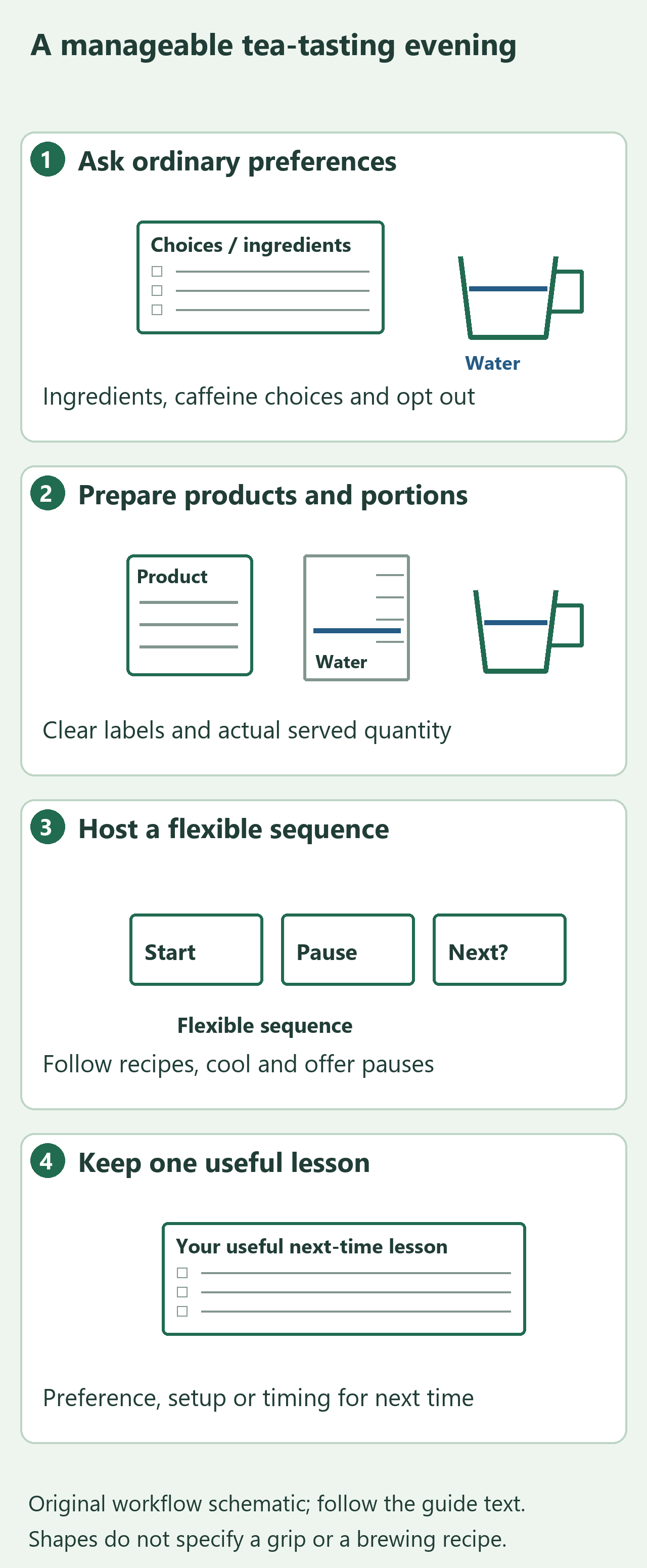
A manageable tea-tasting evening
Examples to work through
These fictional examples illustrate practical choices and observations.
One guest requests a caffeine-free evening
Check the exact proposed products and offer water or an alternative the guest accepts. A white-tea category or a “gentle” description is not evidence that the requirement is met. The guest need not disclose medical reasons.
Four small portions exceed the actual decanted liquid
Use the observed amount to revise portions or choose an appropriate larger brewing method before the next product. The fictional 100 mL served target is not proof that a labelled 100 mL bowl supplies it.
The host cannot finish three products in the planned window
Keep the actual preparation and cooling steps intact. Reduce the number of samples or adjust the agreed schedule rather than serving unfinished or awkwardly rushed preparations to preserve the original plan.
A guest does not recognise the advertised orchid note
Accept the guest’s own words or uncertainty. Supplier descriptions are not a vocabulary test. A preference such as “I would drink this again” can be the useful outcome of the evening.
Tea tasting evening host planner
Use these optional reminders to mark fields you want to keep in your own notes. The downloadable blank sheet contains every record field. Keep your completed record in your own appropriate private place.
Frequently asked questions
Which tea is automatically best for a night-time tasting?
No category is automatically suitable for every guest. Check actual products, ingredients and stated preferences, including caffeine-free or no-tea choices. Do not use white tea, pale colour or “relaxing” marketing as a caffeine measurement.
How many teas must I serve?
Choose a small set you can identify, prepare and label reliably. There is no required category tour or infusion count. Guests can skip a sample, and the session can end when another round is not wanted.
Does the brewer’s capacity equal the quantity I can serve?
Not necessarily. The nominal or rim label differs from new water added with leaves and liquid decanted. Plan intended portions, then verify the actual serving arrangement and use method-appropriate product directions.
Should guests fill in a detailed tasting scorecard?
Only if they want to. A simple preference or “not sure” is enough for a social evening. Keep preparation notes when needed for the host’s comparison, without requiring guests to use specialist flavour vocabulary or share private information.
Sources and what they support
- UNESCO: tea processing and social practices in China
The 2022 inscription description provides context for varied tea processing and sharing practices. It does not prescribe a home tasting sequence or brewing method.
- UK Tea & Infusions Association: tea varieties
Named tea styles, blends and scenting examples. The association’s descriptions do not guarantee the flavour of a particular packet.
- Rishi Tea: Simple Brew instructions
The maker’s pot workflow and instruction to follow the exact tea’s dose, temperature and time, then decant fully. Its own vessel quantities are not universal mug recipes.
- Rishi Tea: Gongfu Cha
A gaiwan or small pot, receiver, cups and successive short infusions. It does not supply one recipe or a detailed grip for every set.
- NCCIH: Green Tea
Green-tea processing, caffeine and the distinction between a drink and concentrated extracts. Health evidence does not turn a tasting preference into a treatment claim.
Sources were checked on 4 November 2026. Seller specifications are attributed to the seller. Check current product and equipment instructions before use or purchase. The planning sheets, hypothetical calculations and scenarios are original editorial aids; they are not product tests or measured tasting results.