Loose-Leaf Tea vs Tea Bags: Choose for Your Routine
Revised · Tea preparation, selection and tasting
Loose leaf and tea bags are ways to package and prepare tea, not automatic taste or quality scores. Choose the exact product and format that fit your mug, equipment, attention and cleanup. Both need a defined tea-to-water preparation and a deliberate end to leaf contact.
Separate the product from its container
A tea bag contains a portion of tea or other ingredients within a filter. A sachet may have a different shape or construction, but the product description still needs checking. Loose leaf requires you to portion the product and provide a suitable filtering or decanting method. Neither format by itself identifies the full ingredients, leaf cut, processing or flavour you will prefer.
UKTIA’s processing account describes leaf-size sorting, different cutting or rolling methods and blending before packaging. Its varieties include plain and flavoured products. Therefore, compare actual products rather than assuming everything inside a bag is one kind of tea and everything loose is another.
Match the format to an ordinary task
On a narrow screen, scroll this table sideways to read all columns.
| Task | Bag or sachet considerations | Loose-leaf considerations |
|---|---|---|
| One desk mug | Portion and filter supplied; still remove it at the intended endpoint | Needs a suitable removable infuser, dose measure and wet-leaf rest |
| Travel with limited equipment | Check actual water, mug and disposal access; one bag does not fit every fill | Carry a suitable brewer/filter and a practical cleaning plan |
| Several servings from a pot | Follow the product’s bag-to-water directions | Measure for the actual water and decant through suitable filtration |
| Successive short infusions | Check whether that exact product supplies an appropriate method | Use product-specific directions and retain the original leaf history |
| Fine particles | Inspect whether the bag remains intact and follows its use guidance | Choose a filter that retains the actual leaf cut |
Convenience includes the whole task, not just putting tea in water. A bag may reduce measuring and filtering steps. Loose leaf may suit a reader who already owns an appropriate basket or pot and wants to measure portions. Neither is automatically easier for a person whose washing, grip or access needs make that particular setup unsuitable.
Read portion labels carefully
Bag count, net dry weight and recommended bags per water amount are different pieces of information. If a fictional box states 30 bags and 60 g net tea, division gives an average of 2 g per bag. That is label arithmetic, not a measurement of every individual bag and not a recipe for your product.
For loose leaf, grams can define a dose directly when the instructions use grams. Spoon measures need the stated spoon size and level or rounded basis. Different leaf shapes occupy a spoon differently; do not silently convert every teaspoon into a fixed dry weight.
Match the actual preparation to the water you add. A large mug filled above the packet’s intended amount changes the bag-to-water ratio. A loose-leaf dose likewise means little without its water amount. Use the actual product’s complete directions or seek missing details rather than filling them from the format name.
Make leaf separation part of either method
Use a clean food-use vessel and drinking water with an appropriate hot-water source. Follow the product’s dose, water, temperature and time. At the endpoint remove the bag or infuser, or decant a brewer fully into a receiver. A tea bag left in the mug continues contact just as loose leaves do.
Rishi’s Simple Brew guide describes a pot with a removable built-in strainer and a full decant; a separate infuser is not needed for that particular design. That does not mean all loose-leaf pots have filtration or that every basket fits every leaf. Check your actual equipment and its care instructions.
If the product directs squeezing, stirring or another action, keep it visible in the method you follow. Otherwise, avoid adding unrecorded handling steps during a comparison. Cool the serving comfortably before tasting and record additions when they matter to your choice.
Compare useful cups instead of asserting a winner
If you compare a bagged product with a loose-leaf product, use each exact product’s intended method and ask which prepared serving suits your routine. Keep your observations about taste, preparation effort and cleanup separate. Because products or recipes may differ, the result does not prove that the container alone caused the preference.
For a brewing experiment on one product, use fresh matched portions and change one recorded condition while keeping the rest as similar as practical. A first infusion and a second infusion of already-used leaves are not equivalent fresh controls. The brewing log supports that more specific task.
A seller’s “premium,” “whole leaf” or “pyramid” wording can help identify a claim to check, but it is not your own tasting result. Read the full ingredients and relevant product declarations when those details affect your choice. Do not infer caffeine-free status from a bag shape, loose format or mild flavour.
Reinfusion and cost need actual denominators
Some products can be infused again using their own directions. Do not promise that every loose-leaf tea yields many wanted rounds or that every bag is necessarily single-use. Record the original portion, later water and actual result. If you add fresh tea, that is a new dry-leaf addition.
Compare cost using a stated basis: bought quantity, dry tea used per session and the actual serving denominator. Reusing the same original leaves does not create another dry-leaf charge, but extra dry leaf does. The existing cost worksheet covers this in detail; a slogan such as “loose leaf is always cheaper” leaves out the product, dose and serving.
Include washing, disposal and storage
Follow the equipment’s washing and drying instructions. A basket needs its retained leaves removed and an appropriate clean; a bag still needs a wet resting or disposal route. Check whether your travel or work setting provides the access needed for either format.
Check the actual bag maker’s material instructions and local collection rules. UKTIA distinguishes biodegradable from garden-compostable and discusses different bag materials. That distinction matters; the word biodegradable alone is not permission to put every whole bag into your own compost. This article does not certify the material or disposal route of an unspecified product.
Store either format according to its packaging guidance, sealed in a cool dry place away from strongly scented items. Individual wrappers and tins are packaging details, not proof that every stored product remains fresh regardless of conditions.
Keep a format decision you can act on
Write the task, actual product, preparation directions, equipment needed and one cleanup observation. You can choose bags for travel, loose leaf at a table, or one format for everything. The useful outcome is a preparation you can carry out and a serving you want to repeat—not a required allegiance to a format.
Choose a tea format from the whole routine
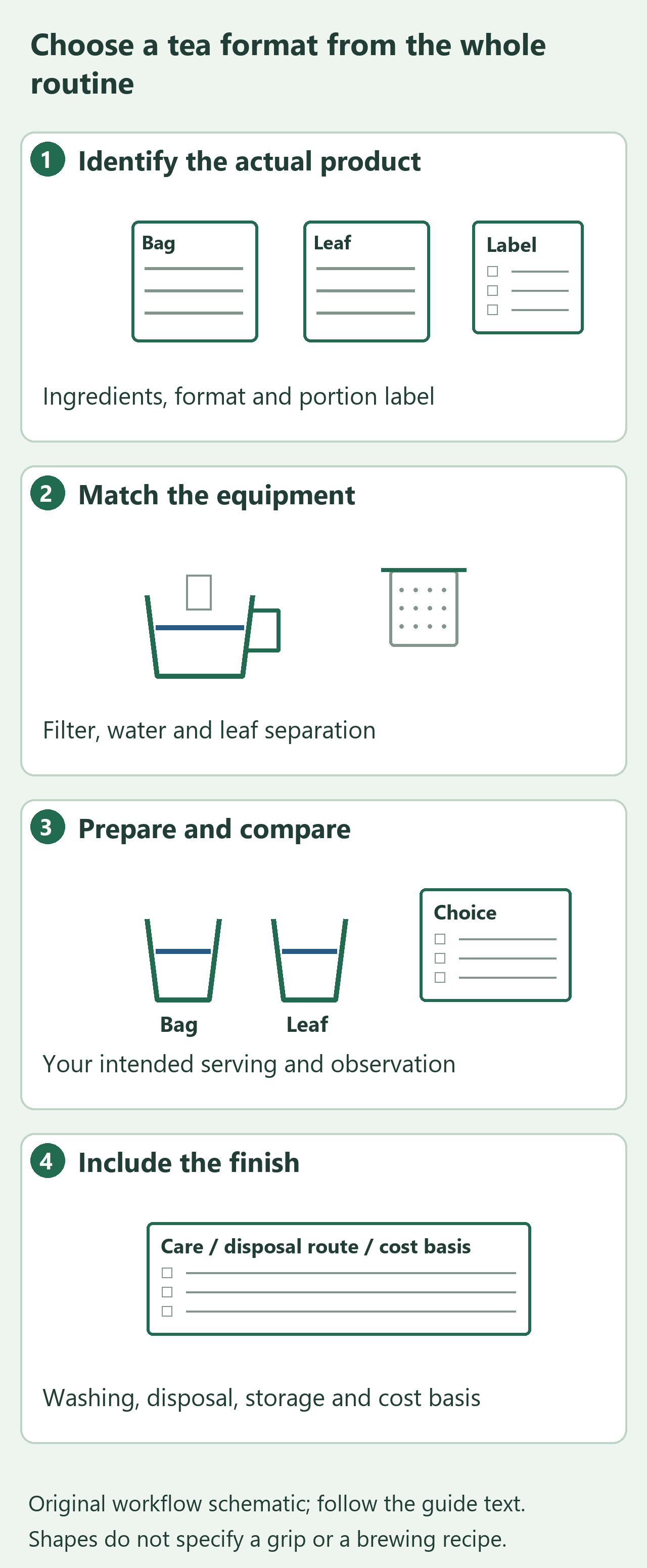
Examples to work through
These fictional examples illustrate practical choices and observations.
A large work mug makes one bag taste weak
Check the exact packet’s water amount and your actual fill before judging the format. You may have used more water than its intended preparation. Follow product-specific bag-count guidance rather than assuming one bag fits every mug.
Loose leaves escape through a decorative infuser
Inspect the leaf cut and choose an appropriate food-use filter that retains it. The problem is the practical filtration match, not proof that loose leaf is intrinsically difficult or low quality.
A reader wants to count every re-steep as a new purchase cost
Keep the dry-leaf charge for the original portion once, unless fresh leaves are added. Compare the resulting session with an explicit served or consumed amount using the cost worksheet; do not switch denominators mid-comparison.
A bag says biodegradable, and home compost is available
Check the maker’s actual instructions and the local route. Biodegradable and suitable for your garden compost are different claims. Do not certify the entire bag’s disposal route from that single word.
Tea format and routine comparison sheet
Use these optional reminders to mark fields you want to keep in your own notes. The downloadable blank sheet contains every record field. Keep your completed record in your own appropriate private place.
Frequently asked questions
Are tea bags always lower quality than loose leaf?
Format alone does not prove a quality ranking or your preferred taste. Compare actual ingredients, clear preparation directions, filtration, convenience and a serving you make. Product and method differences limit what a format comparison can establish.
Do loose leaves need a separate infuser?
They need a suitable way to separate or retain the actual leaves. A pot with appropriate built-in filtration may not need a separate infuser; another vessel may. Check the exact design, leaf cut and maker’s use instructions.
Can I leave the tea bag in while drinking?
That gives continuing leaf contact beyond a timed separation endpoint. If following a removable-leaf method, remove the bag at the intended time. Record actual contact if you choose a different product-specified or intentional workflow.
Which format is cheaper?
Calculate for the actual products, dry quantity used and a stated serving or session basis. Repeated pours from the same leaves do not add a new dry-leaf charge, but added fresh tea does. Neither format is always cheaper independent of product and use.
Sources and what they support
- UK Tea & Infusions Association: processing and blending
Black-tea processing, leaf-size sorting and blending. We use the manufacturing explanation rather than treating leaf format as a quality score.
- UK Tea & Infusions Association: tea varieties
Named tea styles, blends and scenting examples. The association’s descriptions do not guarantee the flavour of a particular packet.
- UK Tea & Infusions Association: making a brew
General preparation, packet instructions, leaf separation and storage. Its category suggestions are references, not recipes for every product.
- Rishi Tea: Simple Brew instructions
The maker’s pot workflow and instruction to follow the exact tea’s dose, temperature and time, then decant fully. Its own vessel quantities are not universal mug recipes.
- Rishi Tea: Gongfu Cha
A gaiwan or small pot, receiver, cups and successive short infusions. It does not supply one recipe or a detailed grip for every set.
- NCCIH: Green Tea
Green-tea processing, caffeine and the distinction between a drink and concentrated extracts. Health evidence does not turn a tasting preference into a treatment claim.
Sources were checked on 4 November 2026. Seller specifications are attributed to the seller. Check current product and equipment instructions before use or purchase. The planning sheets, hypothetical calculations and scenarios are original editorial aids; they are not product tests or measured tasting results.